Three apps. Three very different opinions on what "free" means.
Bazu, Strong (by Strong Fitness PTE Limited), and Hevy (by Hevy Studios S.L.) are the most common names that come up when lifters search for a free workout tracker. All three let you log workouts at no cost. But the free tiers are not equivalent — and the differences show up exactly where they matter most: routine limits, how much history you can actually see, and whether the app works when your gym's Wi-Fi doesn't.
This comparison covers what each app gives you for free, where each one draws the paywall, and which type of lifter each one serves best.
Key Takeaways
- All three apps are free to start, but the free tier limits differ in ways that affect most real training programs.
- Strong's free tier caps you at 3 custom routines — a hard wall that blocks PPL, most 4-day splits, and any program with more than 3 distinct workout days.
- Bazu and Hevy both give 4 free routines — but Hevy locks graph history to 3 months, so your full strength curve disappears behind a paywall after 90 days.
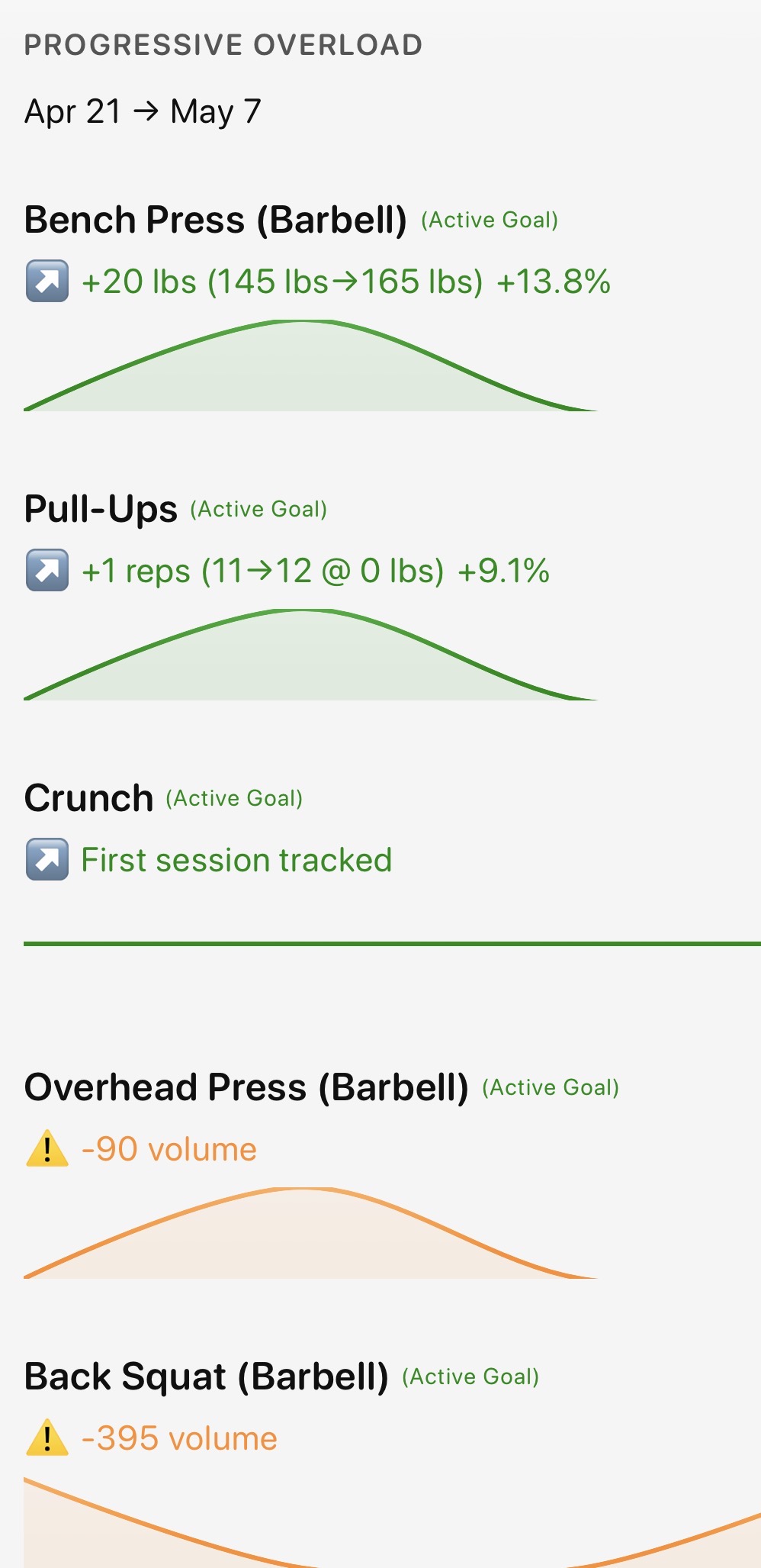
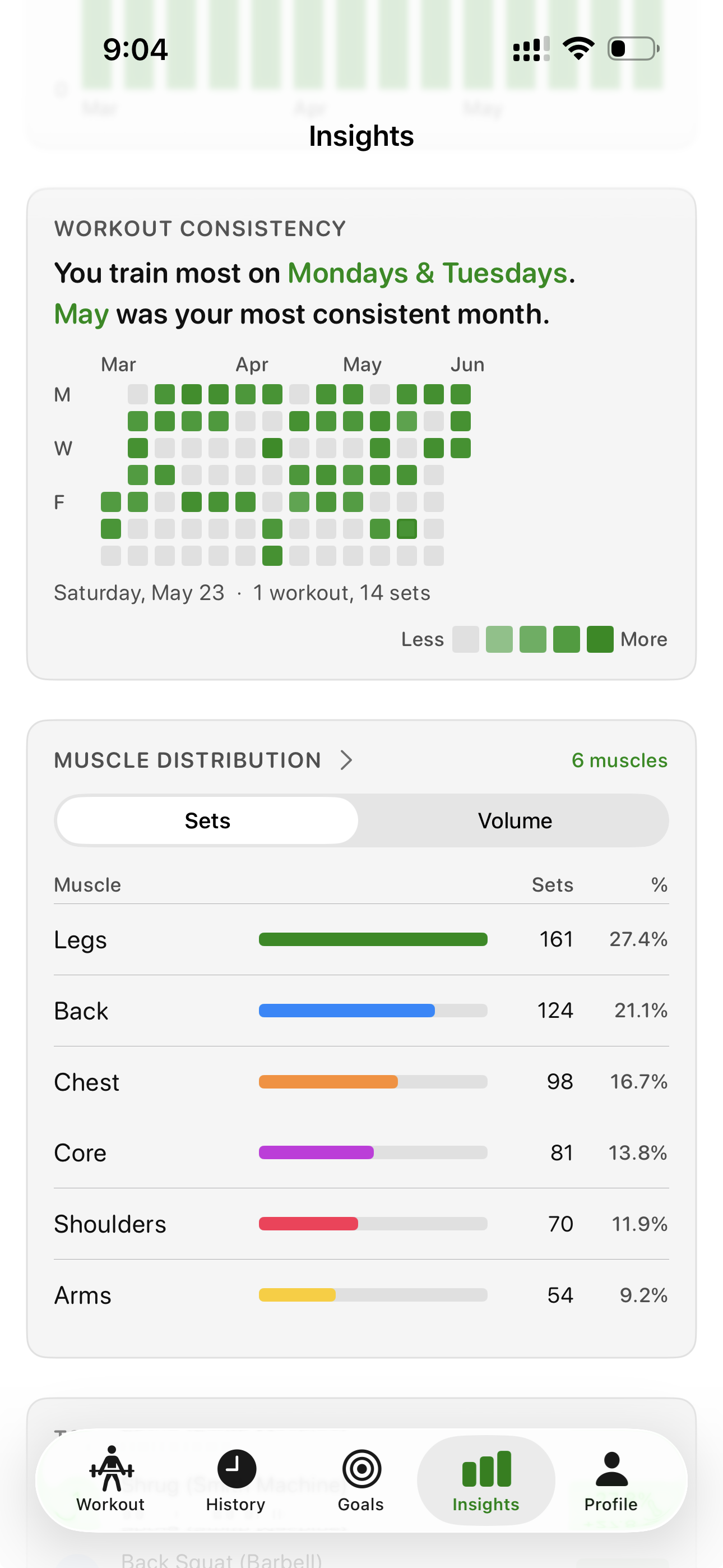
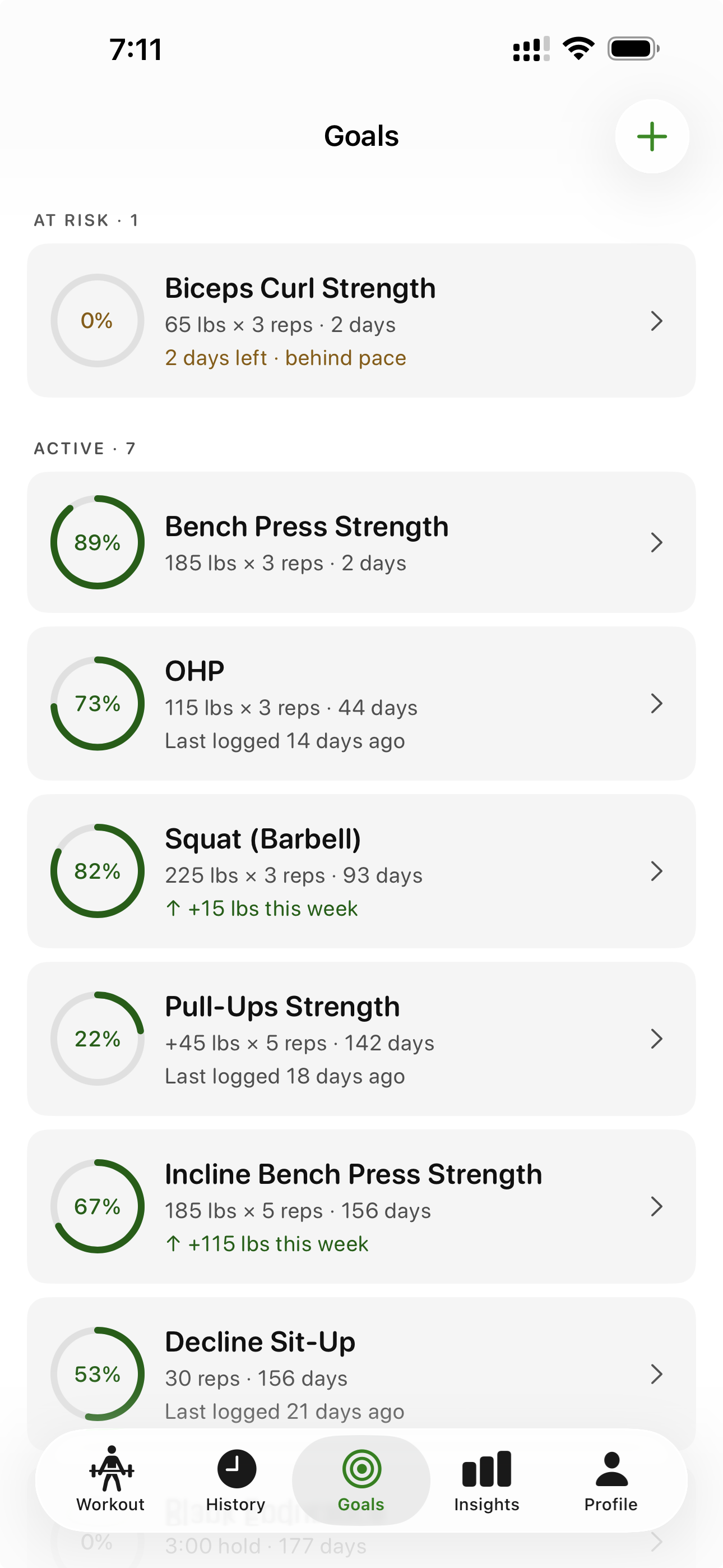
- Bazu gives you unlimited workout history, permanent PR history on every exercise, PR milestones inside completed workouts, muscle breakdown with drill-down, true offline mode, 1RM estimates, and strength goals with target dates at no cost.
- Bazu supports first-class warm-up sets that stay out of PRs, volume, and Progressive Overload calculations. Strong and Hevy also support warm-up-style set tags, but Bazu's release focus is keeping warm-up work visible without polluting working-set metrics.
- Bazu supports phone-free Apple Watch workouts with routine selection, Digital Crown logging, live BPM, PR trophies, and a smart rest timer that runs on-device and syncs automatically when reconnected. Strong and Hevy also support Apple Watch logging; Hevy's official listing also calls out Watch heart-rate tracking.
- Bazu runs on iPhone, Android, and Apple Watch.
Quick Comparison: Bazu vs Strong vs Hevy (Free Tier)
In short: Bazu and Hevy both cap free routines at 4; Strong caps at 3. Bazu is the only one with unlimited graph history and individual-muscle drill-down in the free tier.
| Feature |
Bazu (Free) |
Strong (Free) |
Hevy (Free) |
| In-workout experience |
|
|
|
| Smart, science-based rest timer |
Yes (4 modes, exercise-aware) |
No (fixed duration only) |
No (fixed duration only) |
| Mid-session rest adjustment |
Yes (quick +/− buttons) |
Yes |
Yes |
| Autofill sets (pre-fill from last session) |
Yes |
Yes |
Yes |
| Warm-up sets |
Yes — excluded from PRs, volume, and PO |
Yes (warm-up tags/calculator) |
Yes (warmup set type) |
| Supersets |
Yes |
Yes |
Yes |
| Auto-play music with workout |
Yes (Apple Music) |
Manual |
Manual |
| Apple Watch set logging |
Yes |
Yes |
Yes |
| Live heart rate on Watch |
Yes — BPM during rest |
Not listed as a headline feature |
Yes |
| Post-workout next targets |
Yes — when progression guidance is available |
No published equivalent found |
Pro only (Hevy Trainer) |
| Offline mode |
Yes |
Yes |
Yes |
| Setup & routines |
|
|
|
| Routines |
Up to 4 |
3 (hard cap) |
Up to 4 |
| Program library |
Routine Library — complete programs, free |
No published equivalent found |
Community routine discovery |
| Auto-advancing routine queue (Home) |
Yes |
Manual |
Manual |
| Exercise library |
500+ (guides, anatomy, notes) |
Large library |
Large library + videos |
| Custom exercises |
Up to 10 |
Limited |
Up to 7 |
| Personalized setup (equipment & goal) |
Yes — tunes library & defaults |
Manual |
Manual |
| Progress & analytics |
|
|
|
| PRs |
Permanent history, every exercise + workout history |
Yes |
Yes |
| 1RM estimates & Progress chart |
Yes — estimates + all-time chart |
Pro only |
Limited (3-month cap) |
| Goals with deadlines |
Yes (up to 3 — weight, reps, duration, added-load) |
No |
No |
| Volume analytics |
Yes (full) |
Basic |
Limited (3-month cap) |
| Muscle breakdown |
Yes — individual-muscle drill-down, unlimited history |
Pro only (heatmap) |
Yes — muscle-group level (3-month cap) |
| Cardio distance + Distance PRs |
Yes — pace-ranked |
Manual log |
Manual log |
| Workout history |
Unlimited |
Unlimited |
3-month graph cap |
| Progressive overload suggestions |
Pro feature |
Not available |
Pro only (Hevy Trainer) |
| App & pricing |
|
|
|
| Ads |
None |
None |
None |
| Social features |
None |
None |
Yes (community feed) |
| Platform |
iPhone + Android + Apple Watch |
iOS + Android |
iOS + Android |
| Pro price |
$4.99/mo · $24.99/yr |
$4.99/mo · $29.99/yr · $99.99 lifetime |
$2.99/mo · $23.99/yr · $74.99 lifetime |
Free tier data reviewed against official product pages and App Store listings, July 2026. App-store pricing can vary by region.
Pro Plan Comparison
If you do upgrade, here's what each Pro tier adds beyond the free limits. The most significant functional difference across the three is progression guidance — Bazu and Hevy publish automated guidance systems; Strong's official materials emphasize logging, history, charts, timers, and broad tracking tools rather than an equivalent automated progression coach.
| Feature |
Bazu Pro |
Strong Pro |
Hevy Pro |
| Unlimited Goals with deadlines |
Yes |
No |
No |
| Muscle insights |
Free for all users — drill-down to individual muscles |
Heatmap (Pro) |
Muscle-group distribution chart |
| Progressive overload suggestions |
Smart recommendations + pace selector (Conservative / Standard / Aggressive), shown on iPhone and Apple Watch; Next Workout Targets after sessions |
No published equivalent found |
Hevy Trainer (adaptive) |
| Full history + analytics |
Yes, deeper insights |
Yes + advanced charts |
Yes (removes 3-month cap) |
| Routines |
Unlimited |
Unlimited |
Unlimited |
| Custom exercises |
Unlimited |
Unlimited |
Unlimited |
| Price |
$4.99/mo · $24.99/yr |
$4.99/mo · $29.99/yr · $99.99 lifetime |
$2.99/mo · $23.99/yr · $74.99 lifetime |
Strong's lifetime option ($99.99) is the only one-time payment across all three if you plan to use an app permanently. Hevy Pro is the most affordable at every price point. Bazu Pro is the only tier that adds goals with deadlines — no equivalent in Strong or Hevy at any price. Bazu Pro also uses your training goal to keep progressive overload recommendations in the right rep range — strength, muscle, or endurance — and that goal can be set per exercise, so a heavy squat and a leg press in the same routine get different targets. Note that Bazu's muscle breakdown with drill-down is available free to all users, not a Pro upgrade — Strong's muscle heatmap is Pro-only, and Hevy's muscle-group distribution chart, while genuinely useful, stays at the muscle-group level and follows Hevy's free-history limits rather than drilling down to individual muscles across your full training history.
What Actually Matters in a Free Workout Tracker
Before going app by app, it's worth naming the criteria that actually affect your training — not just what sounds good in a features list.
Routines without a hard cap. Most real training programs require more than 3 distinct routines. Push/Pull/Legs is 3 workouts. Add a deload or accessory day and you're over. Upper/Lower with a third variation, any 4-day bodybuilding split, any periodized program — all exceed 3. A cap at 3 routines means you will either constantly delete and recreate workouts, or you will pay from day one.
History you can actually see. Progress tracking is the reason to log. If your exercise graphs are locked to 3 months, you cannot see your 6-month or 12-month strength curve without a subscription. A true free tier stores your full data. A 3-month window is a trial with extra steps — the limit only bites once you've been training long enough to care most about the data.
Offline reliability. Basement gyms, hotel fitness rooms, rural facilities, and spots with dead zones are common. An app that requires internet to log sets will fail you in exactly the locations where a dedicated gym app should work best.
Goals that move with you. Logging is the foundation, but it's not enough on its own. Knowing whether you're on track toward a specific lift by a specific date turns your history from a record into a plan.
Bazu — Full History, No Ads, Offline First *(iPhone + Apple Watch)*
Bazu is a focused strength training tracker and gym log app built around distraction-free lifting. No social feed. No leaderboards. No ads in any version of the app, free or Pro.

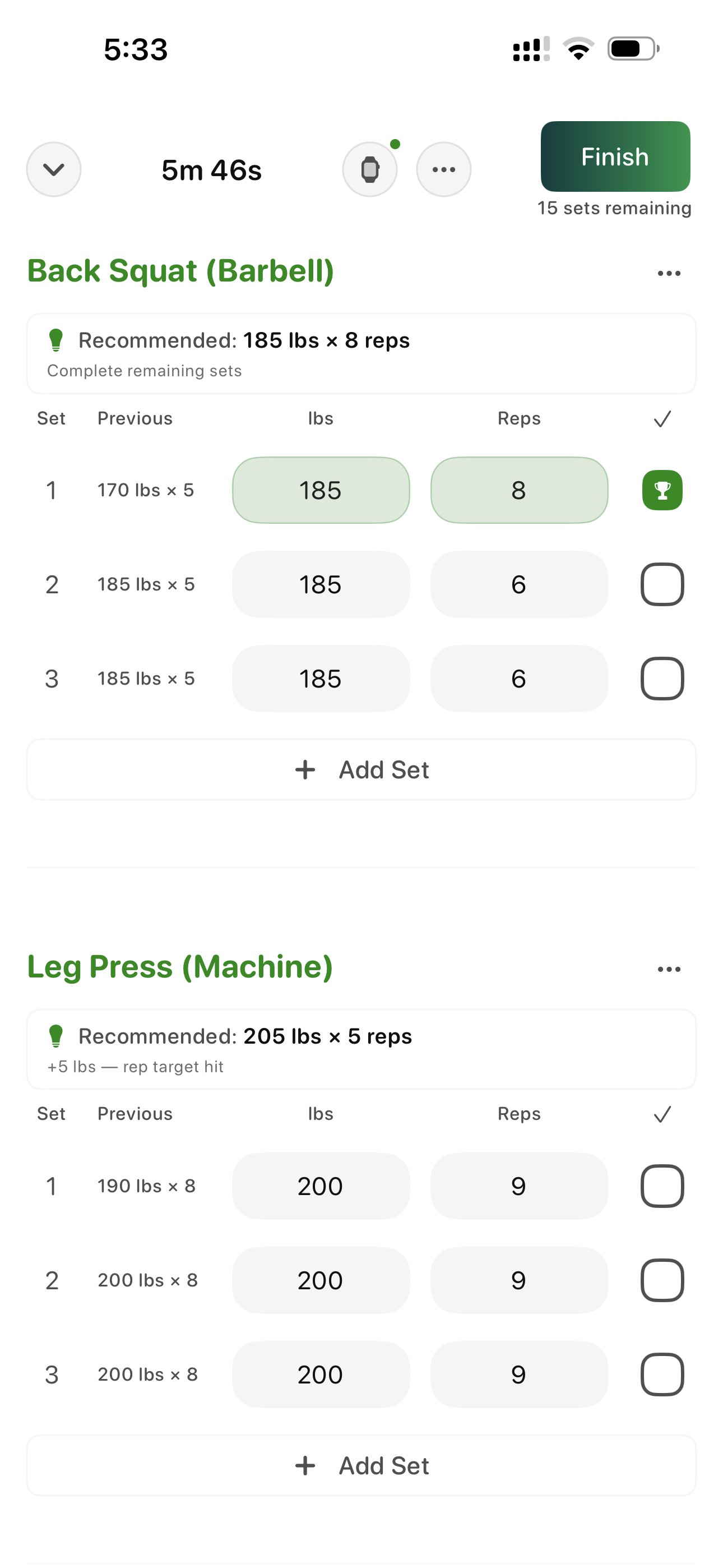
Bazu home view.
What the free tier includes:
- No ads — not in the free tier, not in Pro
- Phone-free Apple Watch workouts — choose a routine from your wrist, log with the Digital Crown, feel smart-rest haptics, see PR trophies, and sync automatically when you reconnect
- Live BPM on Apple Watch — heart rate appears during rest so you can recover longer or push sooner without grabbing your phone
- Smart, science-based rest timer — four modes (Smart Minimum, Smart Offset, Smart Maximum, Fixed Universal) using science-backed minimum rest per exercise — longer for compound lifts (squat, deadlift, bench), shorter for isolation moves (curls, flies), automatically; auto-starts on set completion with quick +/− mid-countdown adjustments
- Warm-up sets — tag warm-ups as
W, log them normally, and keep them out of PRs, volume totals, and Progressive Overload calculations
- Supersets — pair exercises for accessory work, push/pull training, core blocks, or shorter sessions
- Unlimited workout history — every session stored permanently, full graph history with no time restriction
- Offline mode — log workouts without internet, sync automatically when you reconnect; free workout tracker app deep dive covers how this works across devices
- Up to 4 routines — covers Push/Pull/Legs, Upper/Lower, Full Body, and most standard splits
- Save as Routine — open any completed workout in history and save it as a reusable routine in one tap
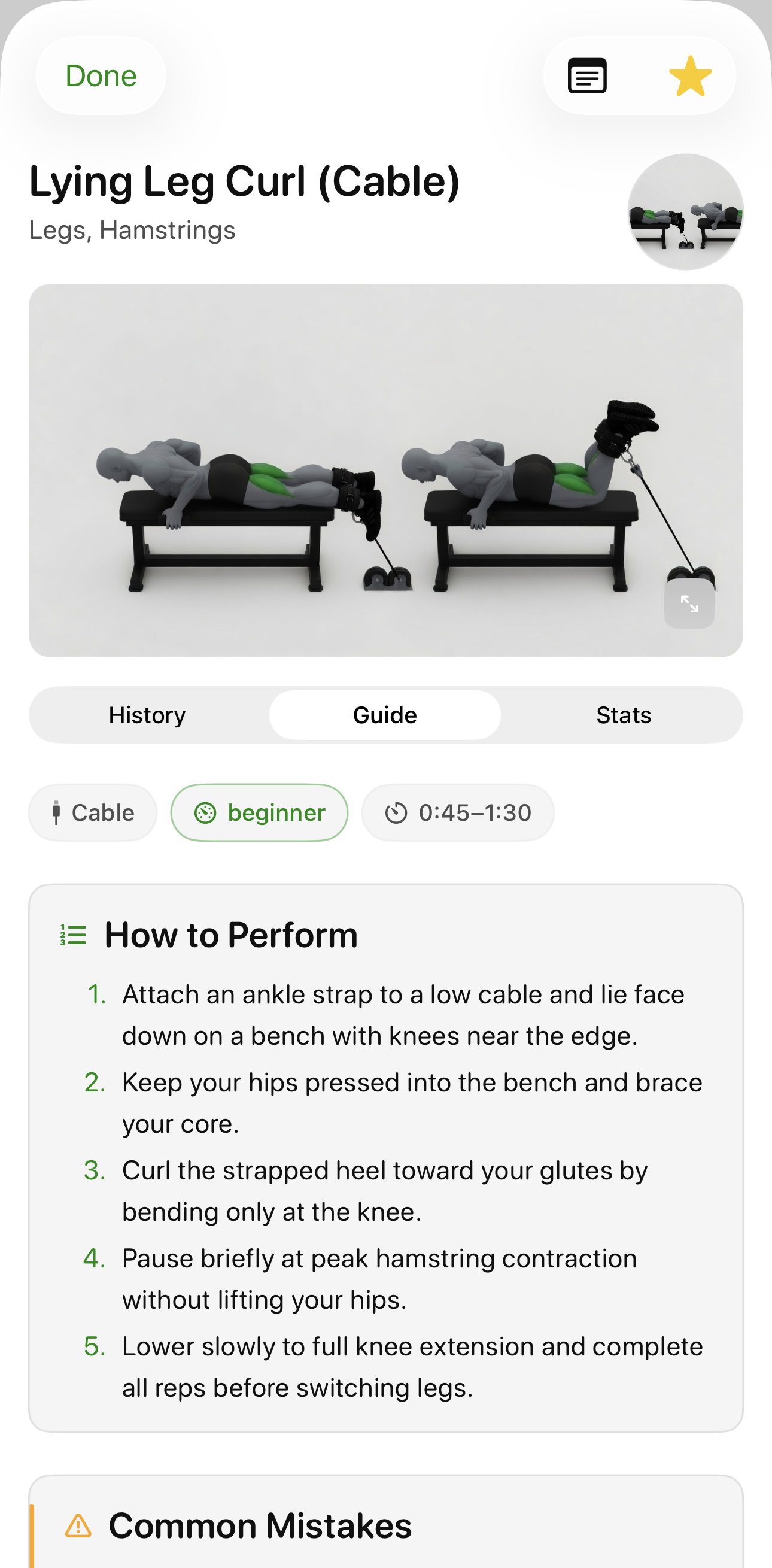
- 500+ exercises — each with anatomy illustration, how-to guide, common mistakes, and a thumbnail image; fuzzy search finds the right movement even with a typo; per-exercise Stats tab shows total sets, volume, and 1RM progression chart
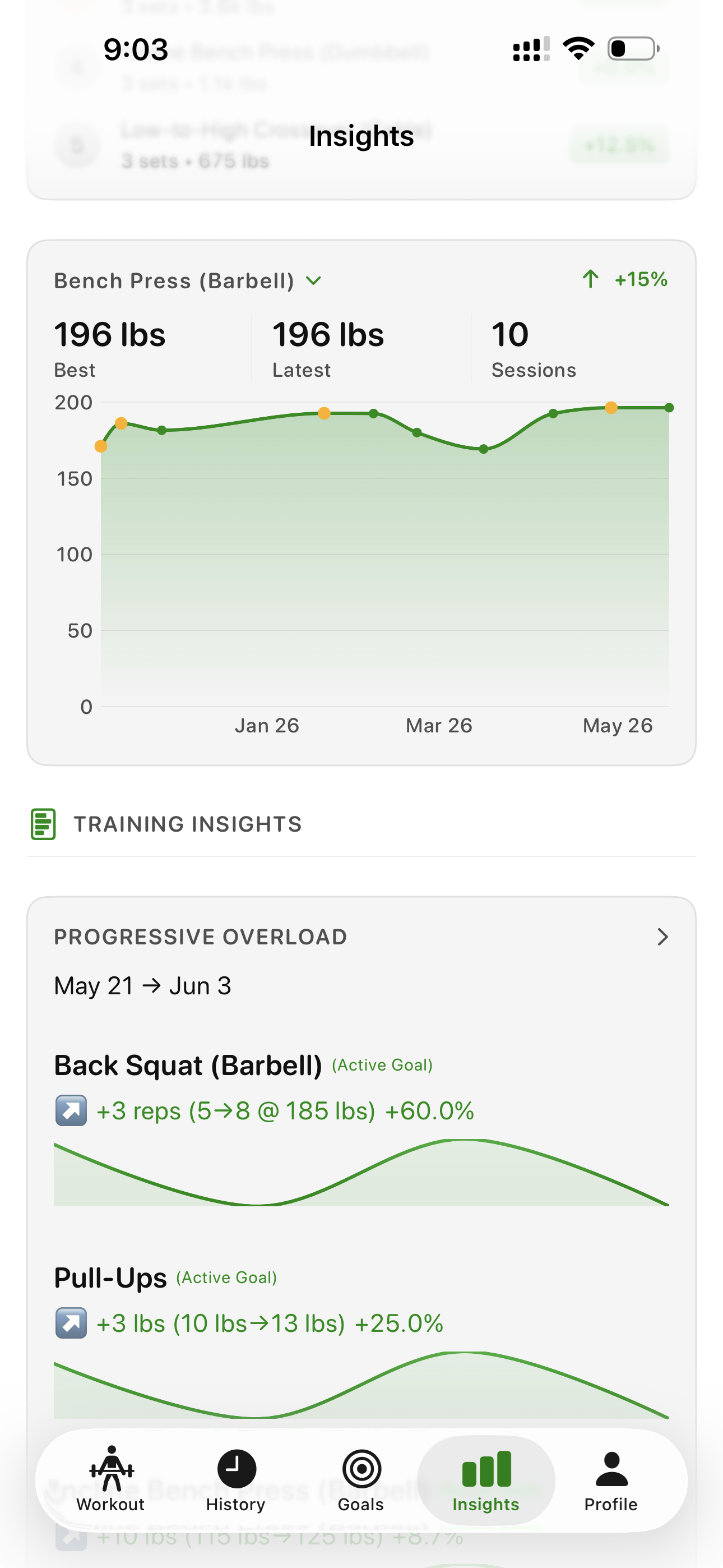
- 1RM Progress chart — a dedicated chart in Insights: tap any exercise you've logged and see your full all-time estimated-1RM trajectory with gold dots on every PR
- Cardio distance tracking + Distance PRs — log treadmill, rowing, and elliptical work by distance and duration, and Bazu detects pace-ranked Distance PRs; the conditioning side of your training gets the same record-keeping as your lifts
- Personalized setup — onboarding asks what equipment you have and what you're training for — Strength, Muscle (hypertrophy), Fat Loss, or Consistency — then tunes the exercise library, science-based default set counts, and goal templates to your program; editable anytime
- Permanent PR history — open any exercise to see all-time bests for load, reps, estimated 1RM, volume, duration, and distance; completed workouts also show the PRs earned in that session
- Home Next Routine — put your routines in a custom order once and Home queues the next one automatically after each completed routine workout, wrapping back to the top at the end of the cycle
- Set notes — quick-add presets (Form Check, Easy +5lb, Joint Pain, and more) or custom notes attached to any exercise, with history
- Permanent PR history — every PR saved permanently across all exercises, searchable and filterable; see exactly how Bazu tracks personal records
- 1RM estimates — modeled strength benchmarks for every exercise, no Pro required
- Volume analytics — weekly totals and trends, full history visible free
- Muscle breakdown with drill-down — six groups (Legs, Chest, Back, Shoulders, Arms, Core), backed by unlimited history; tap any group to see volume per individual muscle
- Goals with deadlines + celebration — set a target with a target date and see daily progress toward it; goals aren't just weight-and-reps — duration goals cover planks, dead hangs, and carries, and added-load goals track the extra plate on weighted pull-ups and dips. Hit the goal mid-session and Bazu surfaces a celebration screen with distinct haptic on the spot
- Auto-play your gym playlist — connect Apple Music once and Bazu starts your playlist the moment you start a workout; no app-switching, and no competitor in this comparison does it
- Last session prefill — weight and reps from your most recent set are shown above the input, so you know exactly what to beat
- Clean, distraction-free UI — dark and light mode, no clutter
Where the free tier has limits:
- 4-routine cap — most splits fit within this; more complex periodization requires Pro
- 10 custom exercises — more room for custom movements before needing Pro
- No Apple Health integration — not currently supported
- No plate calculator — a tool Strong offers that Bazu doesn't
In the logging view, Bazu is the most visually stripped back of the three apps. No exercise icons, no notes placeholders, no stats bar — just bold exercise names, clean input fields, and your previous session data. The new warm-up and superset controls keep the structure available without turning the set list into a dashboard. For lifters looking for a minimalist workout tracker that stays out of the way during a session, this is the fastest screen to read at a glance.
For lifters focused on long-term trends, spotting PRs and tracking progress over time is where Bazu's unlimited history pays off most.
Strong App — Polished, But One Big Wall
Strong has been around long enough to be the default recommendation in most "best workout tracker" roundups. Millions of users, no ads anywhere in the app, clean interface, good logging speed. For a certain type of lifter, it's an excellent choice.

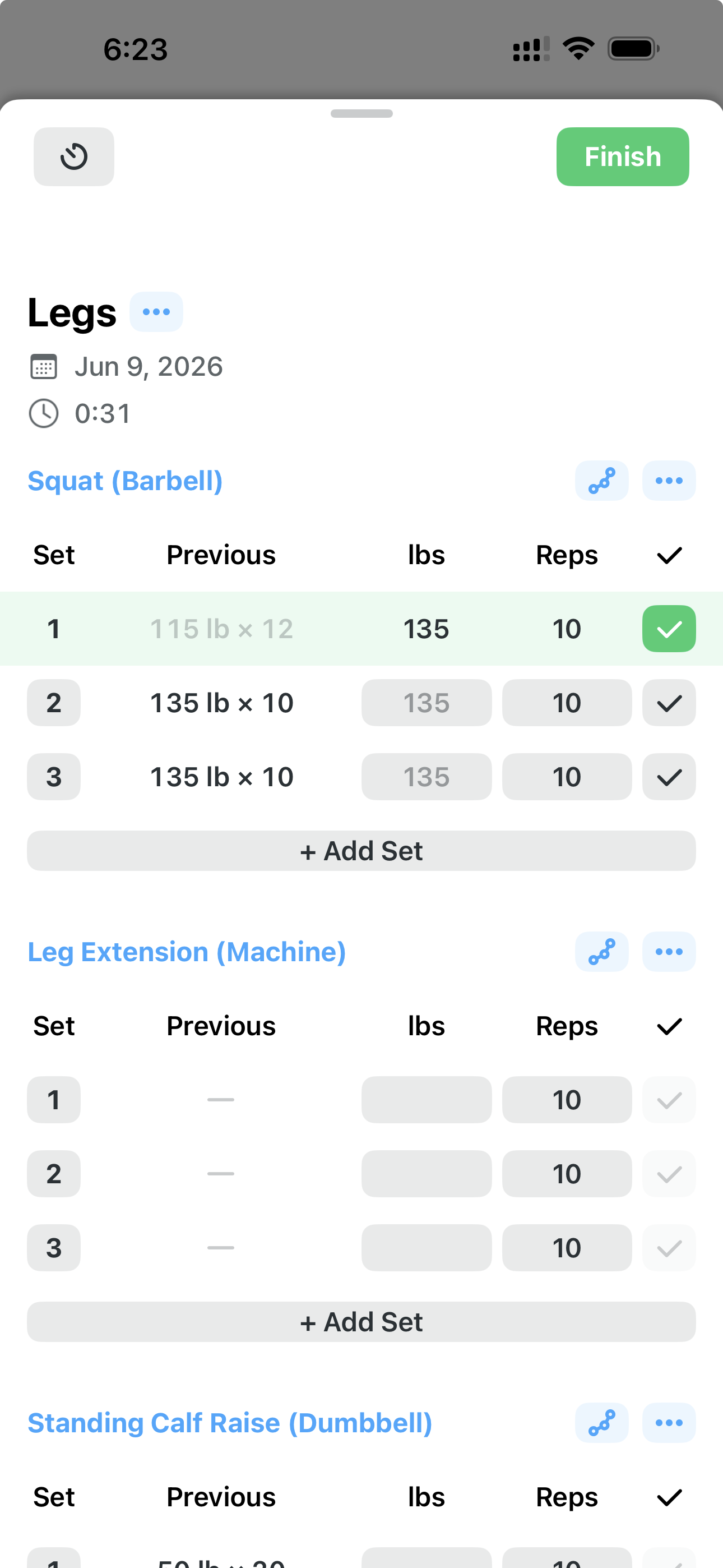
Strong home view.
What the free tier includes:
- No ads — free or paid, Strong doesn't show ads
- Unlimited workout logging with no session caps
- Rest timer with customizable durations
- Warm-up set calculator
- Warm-up, failure, and drop set tagging
- Supersets/grouped exercises
- CSV export
- Apple Health and Apple Watch integration
- Basic progress tracking and PR detection
- iOS + Android
The one issue worth knowing before you download:
Strong's free tier limits you to 3 custom routines. That's the number. There's no workaround, no grace period — 3 routines, and then you're prompted to upgrade.
For a full-body program or a simple upper/lower split with two days, 3 routines is enough. But Push/Pull/Legs is already at the limit. Add any variation — a deload week, a separate conditioning session, a different template for travel — and you're over. Most intermediate lifters running standard programming will hit this wall within the first week of setup. Strong's answer to this is a Pro subscription at $29.99 per year or a $99.99 lifetime purchase — a one-time option that gives you everything Strong Pro offers permanently, with no future subscription required.
Other limitations of the free tier:
- Advanced charts, muscle heatmap, and body measurement tracking are Pro-only
- No goal tracking with target dates
- Custom exercises limited in free (no specific published count)
Strong's logging view adds contextual detail that Bazu omits: rest time shown as a divider between each set, reps pre-filled from your last session, and your workout name and date in the header. More elements on screen than Bazu, but each has a purpose — they reduce decisions rather than adding noise.
Strong is a well-built app with a free tier that works well for lifters running simple programs. If you're likely to go Pro eventually, the $99.99 lifetime option is worth considering over annual billing. For a focused, one-on-one look at switching from Strong — pricing, the 3-routine cap, and what moves over — see our best Strong app alternative guide.
Hevy — Most Social, History Capped at 3 Months
Hevy is the largest app in this comparison by user count, with strong community features, instructional exercise videos, and a genuinely usable free tier in many respects. It's the default choice for lifters who want to share workouts, follow training partners, or browse community routines.

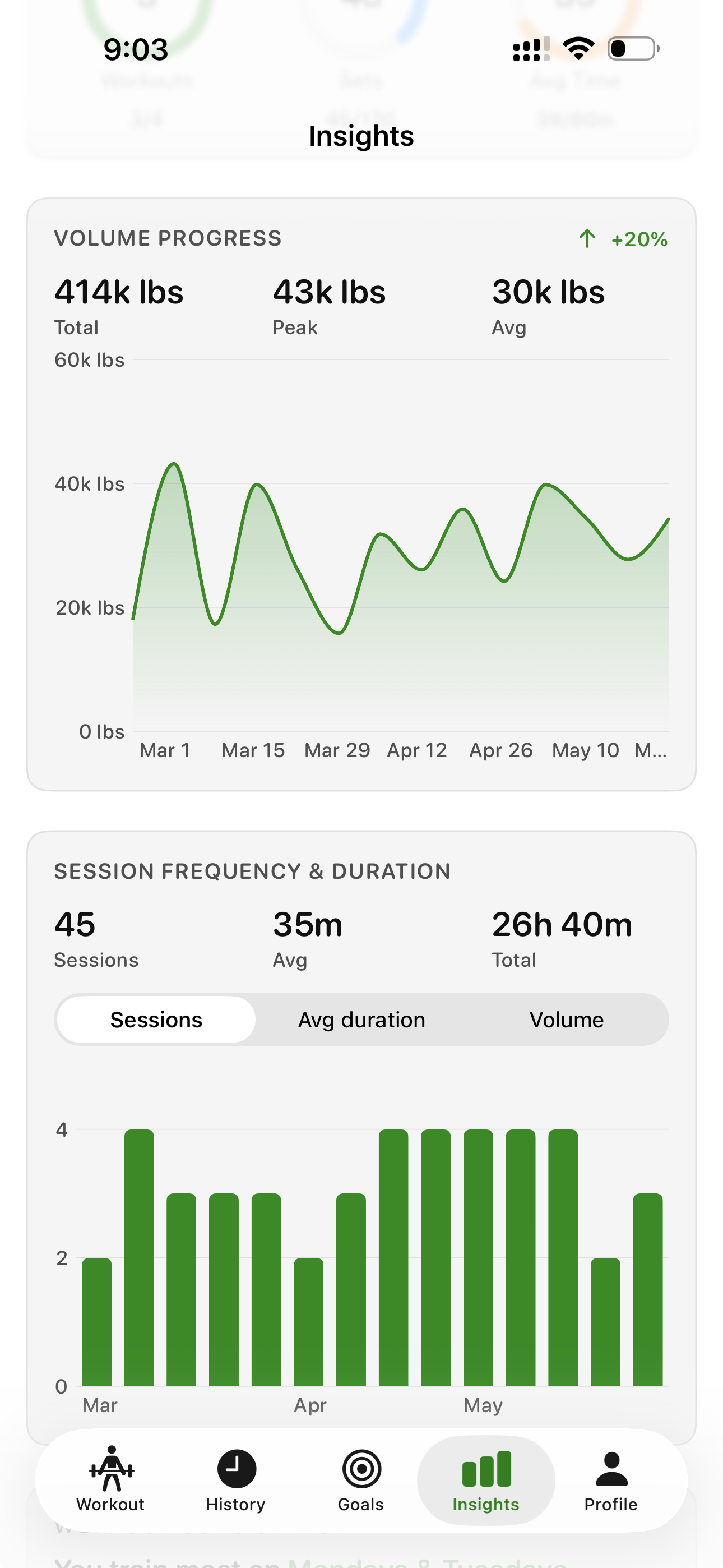
Hevy home view.
What the free tier includes:
- Unlimited workout logging
- Up to 4 routines (same as Bazu; one more than Strong)
- Up to 7 custom exercises
- PRs tracked across all sessions
- Exercise library with instructional videos (Bazu offers illustrated guides + anatomy instead of video)
- Muscle distribution chart — volume and set counts by muscle group (capped to the 3-month window on free; group-level, not per-muscle drill-down)
- Rest timers
- Warmup, drop, failure, and superset set types
- Community feed: follow others, post workouts, browse public routines
- Apple Watch logging with heart-rate tracking
- iOS + Android
The primary limitation for serious lifters:
Hevy's exercise graphs only show 3 months of history in the free tier. You can log unlimited sessions — all your data is saved — but the visual progress charts are capped at 90 days unless you subscribe. For a lifter who signs up in January and reaches April still on the free tier, their January baseline is gone from the graphs. You cannot see your full strength curve, your 6-month volume trend, or your year-over-year PR progression without paying.
This limit gets more significant over time. A new lifter won't notice it. A lifter six months in will hit it exactly when their training history has become most valuable.
Other considerations:
- Hevy Pro is listed at $2.99/mo · $23.99/yr · $74.99 lifetime in the U.S. App Store — the most affordable tier in all three pricing brackets
- Measurement tracking is limited in the free tier; full body measurements require Pro
- Advanced stats are limited free
- Hevy Trainer, an adaptive coaching/progression feature, is Pro-only
- The social features are a genuine positive for community-motivated lifters and a potential distraction for lifters who prefer a focused experience
Hevy's logging view is the richest visually — exercise illustrations, a live stats bar showing volume and set count, and a "Previous" column pulled from prior sessions. More information on screen during a session, which serves lifters who want context at a glance; more visual elements for those who prefer a quieter interface.
Hevy's free tier is the right choice if community motivation matters to you and you're early enough in your training that 3 months of graph history covers what you need to see.
Who Should Use Which App
Pick Bazu if:
- You're on iPhone or Android and want full graph history with no time restriction
- You want a rest timer that adjusts duration per exercise instead of one fixed number you pick yourself
- You want warm-up sets to stay visible without counting toward PRs, volume, or progression suggestions
- You want permanent PR history on every exercise and inside the workout that earned each record
- You train on a PPL, Upper/Lower, or similar split (4 routines covers it)
- Your gym has poor signal, or you train in locations where offline logging matters
- You want to set strength goals with target dates, track daily progress, and feel a celebration the moment one closes out
- You want to see which muscles you're actually training — drill-down breakdown across six groups, free for all users
- A clean, focused experience without social features is what you're looking for
Pick Strong if:
- Your training program uses 3 or fewer distinct routines
- Apple Health integration, CSV export, warm-up calculators, or plate calculators matter to your workflow
- You're likely to go Pro and want a one-time payment option ($99.99 lifetime)
- Community features are not important
Pick Hevy if:
- Social motivation works for you — following training partners, posting sessions, browsing community routines
- You want community features and still get 7 custom exercises free
- You're earlier in your training and 3 months of graph history covers your current needs
- You want Wear OS support alongside Apple Watch and visible workout heart rate
- You want the lowest-cost path to Pro if you upgrade ($23.99/yr or $74.99 lifetime)
FAQ
Is the Strong app free tier worth it?
Strong's free tier is worth it for lifters running programs with 3 or fewer routines — the app has no ads, good logging speed, a warm-up calculator, and Apple Health integration at no cost. The 3-routine cap is the single issue that affects most lifters: if your program has more than 3 distinct workout days, you will hit it immediately. If you're running a basic full-body or two-day split, the free tier works well. For anything more structured, the $29.99/year Pro tier (or $99.99 lifetime) is the realistic starting point.
What are Hevy's free tier limits?
Hevy's free tier gives you unlimited logging, up to 4 routines, up to 7 custom exercises, rest timers, PRs, and community features. The main practical restriction for long-term lifters is the graph history cap: exercise charts only show 3 months of history free. After that, your strength curve is only visible with a Pro subscription at $23.99/year or $74.99 lifetime. Measurement tracking and advanced stats are also limited free.
What is the difference between Bazu and Hevy?
The core differences are history access, platform, offline capability, and design philosophy. Bazu gives you full unlimited graph history free; Hevy caps long-term graph history unless you upgrade. Bazu has true offline mode with auto-sync; Hevy supports offline Watch workouts and syncs when reconnected. Hevy is on iOS and Android; Bazu runs on iPhone, Android, and Apple Watch. Bazu offers 10 custom exercises free versus Hevy's 7. Hevy is built around a social community — following, posting, sharing workouts. Bazu has no social features and is designed for focused, private training. Both apps support Apple Watch logging and heart-rate visibility; Bazu adds permanent PR history on each exercise, PRs in completed workout history, a smart exercise-aware rest timer, warm-up sets that stay out of PR/volume/overload metrics, and strength goals with target dates. Both apps surface muscle insights, but Hevy's distribution chart works at the muscle-group level and follows Hevy's free-history limits, while Bazu drills down to individual muscles with unlimited history at no cost.
Which workout tracker has the best free tier?
For lifters running standard splits (PPL, Upper/Lower, 3–4 days/week) on iPhone or Android, Bazu's free tier covers the most ground: no time restriction on history, editable completed workouts, permanent PR history, offline mode, 4 routines, smart warm-up weights, supersets, 1RM estimates, volume analytics, goals with deadlines, phone-free Apple Watch workouts with Digital Crown logging and live BPM during rest, a smart exercise-aware rest timer, and 10 custom exercises. For lifters who want a clean, ad-free experience with a simple program (3 routines or fewer), Strong is a reliable free option. For lifters who want community features, Hevy is the choice — with the understanding that long-term graph history requires Pro.
There is no universal winner. For iPhone or Android users who want minimalist and long-term tracking, Bazu is usually the better fit. For a mature cross-platform app, Strong is great if the routine cap does not block your setup. For community motivation, Hevy is hard to beat.
Can I track progressive overload for free on any of these apps?
Yes — all three support progressive overload tracking for free by logging sets, reps, and weight over time. You can always see what you lifted last session and manually increase from there.
Automatic guidance is a separate feature. Bazu Pro adds smart recommendations based on your last session, with a pace selector, next-set targets on iPhone and Apple Watch, and post-workout Next Workout Targets. Hevy Pro adds Hevy Trainer, an adaptive system that adjusts target weights based on your performance. Strong's official feature list emphasizes logging, history, charts, timers, and broad tracking tools rather than an equivalent automated progression coach.
For a practical framework on applying progressive overload consistently, see Progressive Overload 101.
Can I request features or report bugs in Bazu?
Yes — Bazu has a built-in feedback option in the app. You can submit feature requests or report issues directly without leaving the app. The team actively reviews submissions, so if something is missing or not working as expected, it's worth sending it through.
If you're on iPhone or Android (or want to log sets from your Apple Watch) and want a free workout tracker that stores your full training history, keeps permanent PRs attached to each exercise, works in the gym without internet, and keeps you focused on lifting instead of scrolling, Bazu was built for exactly that.
Download Bazu on the App Store or get it on Google Play