Turn the convention into a useful training history. Once you know what to enter, log your next workout in Bazu on the App Store or Google Play. Bazu keeps each exercise's sets, permanent PR history, and charts together. That makes the convention matter in practice: a 25 lb per-hand curl stays comparable with the next per-hand curl instead of being mixed with a 50 lb combined entry. Workout logging, PR history, and charts are included in the free tier.
If a completed workout contains a genuine mistake — the wrong weight, reps, set count, superset pairing, title, or date — edit that session in Bazu History. Bazu repairs affected PRs and Insights automatically. That correction tool is for making the record truthful; it is not a reason to retroactively convert an entire block from one consistent logging convention to another.
Dumbbells and kettlebells: enter the weight of one
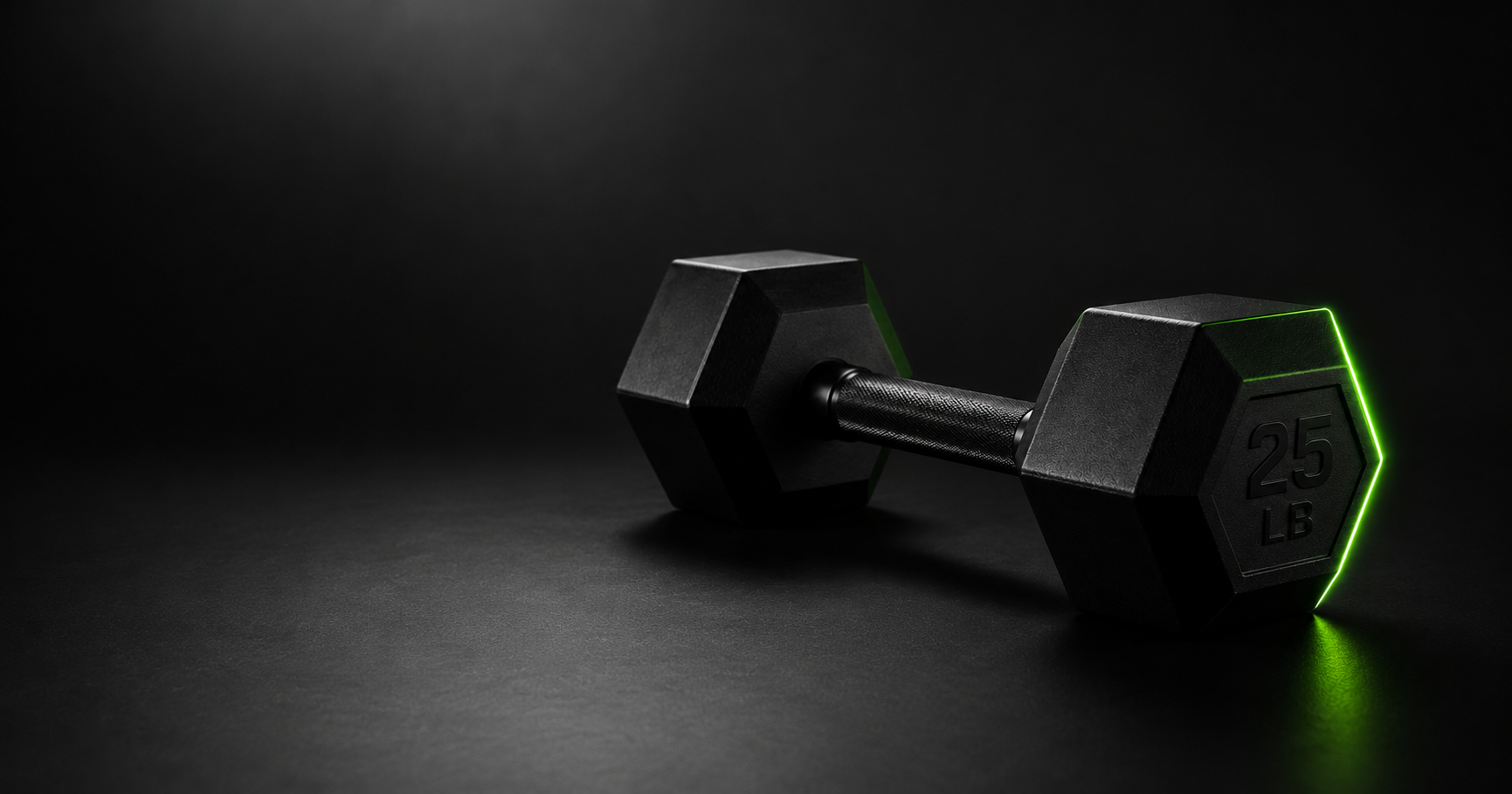
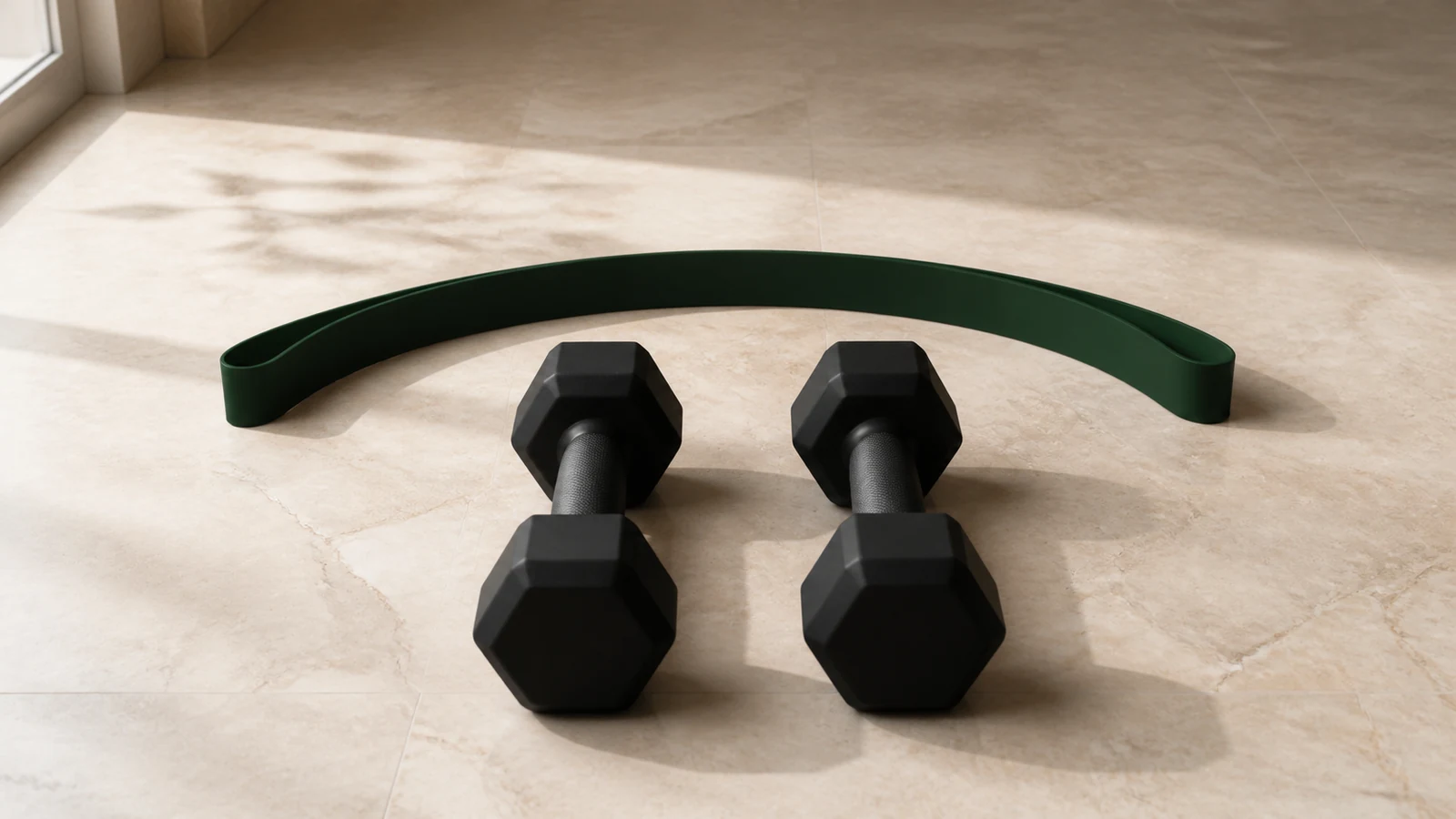
For dumbbell exercises, enter the labeled weight of one dumbbell. This is true whether you move both arms together or train one side at a time.
Two dumbbells moving together
You perform 10 standing curls with a 25 lb dumbbell in each hand.
- Weight:
25 lb
- Reps:
10
- Log entry:
25 lb × 10 reps
You held 50 lb in total, but entering 25 lb preserves the more useful question: Which dumbbells should I pick up next time? If you progress from the 25s to the 30s, the log also shows the actual step each arm took.
The same convention works for dumbbell bench presses, shoulder presses, lateral raises, flies, and Romanian deadlifts. It does mean a calculated volume total will use the per-dumbbell reference rather than the pair's combined external load. That tradeoff is intentional: exercise history, load PRs (personal records), and progression targets remain easy to interpret.
One dumbbell used by both hands
If one implement supplies the entire external load, enter its full labeled weight.
- 50 lb goblet squat: log
50 lb
- 30 lb overhead triceps extension held with both hands: log
30 lb
- 45 lb dumbbell pullover: log
45 lb
Do not halve the number because two hands touch the same implement.
Kettlebells and handheld plates
Use the same rule:
- One kettlebell or plate: enter its labeled weight.
- A matched pair: enter one implement's labeled weight.
- Two different weights: track sides separately or use a note; do not average them.
Keep materially different variations separate. A one-kettlebell front squat, a two-kettlebell front squat, and a goblet squat place and distribute the load differently even if one number happens to match.
One arm or one leg: log reps per side
A unilateral exercise trains one side at a time. The cleanest convention is to record the load used by the working side and the reps completed per side.
When you count each side separately
You perform 10 right-arm rows and 10 left-arm rows with a 40 lb dumbbell.
- Weight:
40 lb
- Reps:
10
- Sets: one completed set, assuming your program treats both sides as one set
Do not enter 20 reps. Twenty describes the combined number of arm actions, but it can make the set look twice as strong in rep PR and estimated 1RM calculations.
When you count alternating reps in total
If you counted every alternating rep—right as 1, left as 2, right as 3—convert the total to reps per side.
- 20 alternating curls total =
10 reps per side
- 16 walking-lunge steps total =
8 reps per side
For an odd total, the sides did not receive equal reps. Log the weaker side's completed reps or track left and right as separate exercise variants.
When the two sides use different loads or reps
Do not average 30 lb × 10 on the left and 35 lb × 8 on the right. Averaging creates a set that never happened.
Use one of these approaches:
- Create distinct left and right exercise entries.
- Log separate sets and label the side in a note.
- If the difference was accidental and small, log the weaker side as the shared baseline and note the mismatch.
This is not universal. Some workout apps contain an explicit unilateral mode that doubles volume behind the scenes. Use that feature's instructions when available.
Barbells, Smith machines, and plate-loaded equipment
Barbells, trap bars, and EZ-curl bars
Enter the total loaded system:
weight to log = implement weight + plates on the left + plates on the right
Example:
- Bar: 45 lb
- Plates: 45 lb on each side
- Entry:
45 + 45 + 45 = 135 lb
Check the implement rather than assuming its weight. Competition weightlifting bars are standardized at 20 kg for men and 15 kg for women (International Weightlifting Federation), but technique bars, fixed barbells, trap bars, safety squat bars, and EZ-curl bars vary.
Small collars are commonly left out of a general gym log. Include them if their load is meaningful to your training or your competition practice, but then include them every time.
Smith machines
A Smith bar does not automatically equal a free barbell. Counterbalancing and model design can change its starting resistance.
- If the machine labels the starting resistance, add that number to all plates.
- If it does not, log the plates you added and note the machine or gym.
- Do not transfer a Smith-machine history directly to a free-barbell exercise.
Plate-loaded machines and leg presses
Log every plate you added. Include the empty carriage or lever only when the manufacturer labels a starting resistance that you can reproduce.
For a leg press with two 45 lb plates on each side:
- Plates added:
4 × 45 = 180 lb
- Labeled starting resistance: add it if known
- Unknown starting resistance: do not guess; log
180 lb and keep using that convention
The number is specific to that machine. Sled angle, leverage, friction, range of motion, and carriage weight can make two machines with the same plates feel different.
For a unilateral plate-loaded machine, enter the load placed on the working lever. Keep unilateral and bilateral versions as separate exercises when switching between them changes the mechanics.
Machines and cables: log the displayed setting
Selectorized machines
On a machine with a pin or dial, enter the number printed at the selected position. Do not add the moving arms, estimate leverage, or try to convert the setting into an equivalent barbell load.
Also record the setup variables that affect repeatability:
- seat height
- back-pad or chest-pad position
- handle position or grip
- range of motion
- machine identity when your gym has more than one model
If two independent arms each have their own stack and both are set to 40 lb, log 40 lb per side. If both hands move one shared lever connected to one 80 lb stack, log the single 80 lb setting.
Cable exercises
For one cable stack, log the number shown by the selector. If two hands share one rope or straight bar attached to that stack, enter the setting once.
For two independent columns—such as a dual-cable fly with each stack set to 20 lb—enter 20 lb, the per-side setting.
Do not routinely convert a stack label for pulley ratio. Cable ratios change handle resistance: a manufacturer example explains that a 1:1 system makes a selected 20 lb feel approximately like 20 lb, while a 2:1 arrangement makes it feel approximately like 10 lb at the handle (REP Fitness). Attachments, cable routing, friction, and machine calibration add more variation.
The practical solution is simpler: use the same station, attachment, pulley height, and selector setting. When you switch to a meaningfully different setup, create a new exercise variant or write a note instead of rewriting old history.
Bodyweight, weighted, and assisted exercises
Unweighted bodyweight work
Enter 0 in the weight field and log the reps or duration.
- Pull-up:
0 lb × 8 reps
- Push-up:
0 lb × 20 reps
- Bodyweight dip:
0 lb × 10 reps
- Plank:
0 lb plus the completed duration
Do not automatically add your full scale weight. Different bodyweight movements move different fractions of body mass. Even within one push-up, the load supported by the hands changes with position: one study measured roughly 69% of body mass at the top and 75% at the bottom in its trained male sample (Suprak et al., 2011). Changing hand elevation, foot elevation, technique, or body proportions changes the value again.
That is why reps, duration, range of motion, and variation are usually cleaner bodyweight progress markers than estimated tonnage.
Weighted bodyweight work
Enter only the external load added to your body.
- Pull-up with a 25 lb plate:
25 lb × 5 reps
- Dip with a 40 lb belt load:
40 lb × 8 reps
- Push-up with a 20 lb vest:
20 lb × 12 reps
Do not add scale weight to the 25, 40, or 20. This keeps the transition from bodyweight to added load clear and makes the equipment choice reproducible.
If your bodyweight changes materially during a training phase, record it separately or add an occasional note. It provides context without changing the exercise's weight convention every session.
Assisted pull-ups and dips
Assistance is the inverse of lifted load: less assistance is harder. A generic positive weight field usually assumes more weight is harder, so entering 80 lb assistance can make the easiest set appear to be the strongest.
For a tracker without a dedicated assisted-weight mode:
- Log
0 in the weight field.
- Record reps normally.
- Put the machine setting or band in the exercise name or note.
- Keep machine-assisted and band-assisted variations separate.
For example: Assisted Pull-Up — 40 lb assist, logged as 0 lb × 6 reps.
If your app explicitly supports assisted weight or negative load, follow its instructions instead. Do not combine that system with the zero-plus-note method in the same exercise history.
Bands, landmines, sleds, carries, and other edge cases
Resistance bands
Enter 0 as fixed weight and record the exact band and setup. Band tension changes as the band stretches, and measured force depends on band type, initial length, and elongation. Research on elastic bands has also found that tension rises with elongation and that some measured values differed from manufacturer references (Uchida et al., 2016).
A useful note looks like: blue band, low anchor, hands 24 in from anchor at start.
Landmine exercises
Log the plates added to the free end and note the bar and anchor setup. Do not treat the entire bar-plus-plate mass as if it moved vertically through the same distance; the arc and pivot change the effective resistance.
Sled pushes and drags
Log plates added, then keep sled, surface, distance, and direction consistent. Turf friction and sled design can matter as much as the plates. When available, track distance and duration alongside load.
Farmer's carries
For two matched dumbbells or kettlebells, log one implement's weight and track distance or duration. For a trap-bar carry, log total bar-plus-plate weight.
Chains, weight releasers, and variable resistance
Log the fixed bar-plus-plate weight and describe the variable load in a note. Chain load changes through the range of motion, and band tension depends on stretch, so one fixed number cannot fully represent the set.
Why consistency matters more than "true tonnage"
Volume-load is commonly expressed as sets × reps × external load, but it is only one way to describe resistance-training volume. Reviews note that sets, reps, and volume-load each have useful contexts and limitations (Nunes et al., 2021). More recent work also cautions that increasing calculated total volume does not, by itself, explain how much hypertrophy (muscle growth) will occur (Hammert et al., 2024).
This matters because a workout app can calculate weight × reps correctly and still produce a number that should not be compared across unrelated movements.
Examples:
- A 25 lb dumbbell curl logged per hand is not directly comparable to a 50 lb barbell curl.
- A cable stack at 50 lb on a 2:1 pulley is not the same as a 50 lb dumbbell.
- A 200 lb leg press on one machine is not automatically equal to 200 lb on another.
- A bodyweight push-up logged at zero still creates training stimulus even though its external-load volume is zero.
Use calculated volume to compare the same exercise, convention, and setup over time. Use sets, reps, technique, effort, range of motion, and recovery to interpret the larger training picture.
A five-rule system that keeps your history clean
- Log the number you can reproduce. Use the label on one dumbbell, the total loaded bar, or the displayed machine setting.
- Count unilateral reps per side. If sides differ, track them separately or use the weaker side as the baseline.
- Keep equipment variants separate. A Smith squat, barbell squat, hack squat, and leg press need different histories.
- Correct mistakes, but do not rewrite a convention change. Edit a genuinely wrong entry; create a new exercise variant and note the date when your intentional logging convention changes.
- Add short setup notes. Seat height, pulley height, attachment, band color, machine identity, or assistance level often matters more than another decimal place.
If you are moving from memory or paper, a printable workout log template can help you standardize the fields before importing your routine. Once the convention is stable, use Progressive Overload 101 to decide when to add reps or load. You can also read how Bazu calculates PRs to see how load, reps, bodyweight, duration, volume, and estimated 1RM are interpreted.
Common logging mistakes
- Switching between per-dumbbell and combined dumbbell weight in one exercise history
- Entering 20 reps for 10 reps on each side
- Assuming every bar weighs 45 lb or every Smith machine has the same starting resistance
- Converting one cable machine's pulley ratio but not another's
- Counting assistance as positive lifted load
- Adding full bodyweight to every push-up, pull-up, dip, or lunge
- Comparing volume totals across unrelated exercises as if they measure identical work
- Changing seat, handle, range of motion, or machine without noting it
- Averaging unequal left and right sets into a set that never occurred
Frequently asked questions
For dumbbell curls, do I log the weight of one dumbbell or both?
Log one dumbbell's labeled weight. Two 25 lb dumbbells for 10 simultaneous curls should be entered as 25 lb × 10 reps, not 50 lb × 10.
Do I count 10 reps per arm as 10 or 20 reps?
Enter 10 reps when you completed 10 on each side. If you counted 20 alternating actions in total, convert that to 10 reps per side. Track the sides separately when they did not perform equally.
What weight should I enter for a barbell exercise?
Enter the actual bar or implement weight plus every plate on both sides. Verify specialty, EZ-curl, trap, technique, and Smith bar weights instead of assuming they all weigh the same.
What weight should I log on a cable or weight-stack machine?
Enter the displayed pin or selector setting. Keep the station, attachment, seat or pulley height, and range of motion consistent. Do not convert cable ratios unless your app or program explicitly asks for handle resistance.
Should I include my bodyweight in push-ups, pull-ups, or dips?
Usually no. Enter zero for an unweighted movement and only the added external load for a weighted variation. The fraction of body mass moved changes by exercise and position, so full scale weight is rarely a clean universal input.
How should I log assisted pull-ups or dips?
If your tracker has no assisted mode, enter zero and store the assistance setting in the exercise name or note. Lower assistance is progress, so a normal positive-weight field can display the trend backward.
What if I already logged dumbbells as combined weight?
Correct a completed workout if combined weight was entered by mistake. If combined weight was the convention you intentionally used, do not silently rewrite the whole history. Keep it until the end of the training block, or create a new exercise named something like Dumbbell Curl — per hand and start a clean baseline. Add a note with the change date.
Can I compare volume between barbells, dumbbells, machines, and cables?
Not as equivalent physical work. Treat volume-load as a trend for the same exercise and setup. Equipment mechanics, bodyweight contribution, range of motion, and logging conventions differ.
Conclusion
The best workout log is not the one with the biggest total. It is the one that lets you recreate a set, compare it fairly with the last session, and choose the next sensible target.
Use one dumbbell's weight, total loaded bar weight, displayed machine or cable settings, reps per side, and added external load for weighted bodyweight work. When the setup changes, create a new baseline instead of forcing unlike numbers into one history.
Bazu was built around this kind of focused logging. The free tier includes editable workout history with automatic PR repair, permanent PR history, charts, estimated 1RM tracking, muscle breakdown, rest timers, four routines, goals, and phone-free Apple Watch workouts. Bazu Pro adds progressive overload recommendations, intensity pace settings, unlimited routines, and per-exercise rep-range guidance. Download Bazu on the App Store or on Google Play when you are ready to turn a clean logging convention into a useful training history.
References
- Hammert, W. B., et al. (2024). Progression of total training volume in resistance training studies and its application to skeletal muscle growth. Physiological Measurement, 45(8).
- Uchida, M. C., Nishida, M. M., Sampaio, R. A. C., Moritani, T., & Arai, H. (2016). Thera-Band elastic band tension: reference values for physical activity. Journal of Physical Therapy Science, 28(4), 1266–1271.
- Nunes, J. P., et al. (2021). Equating resistance-training volume between programs focused on muscle hypertrophy. Sports Medicine, 51(6), 1171–1178.
- International Weightlifting Federation. Equipment: barbell specifications.
- REP Fitness. What do cable ratios mean and why is that important?.
- Suprak, D. N., Dawes, J., & Stephenson, M. D. (2011). The effect of position on the percentage of body mass supported during traditional and modified push-up variants. Journal of Strength and Conditioning Research, 25(2), 497–503.