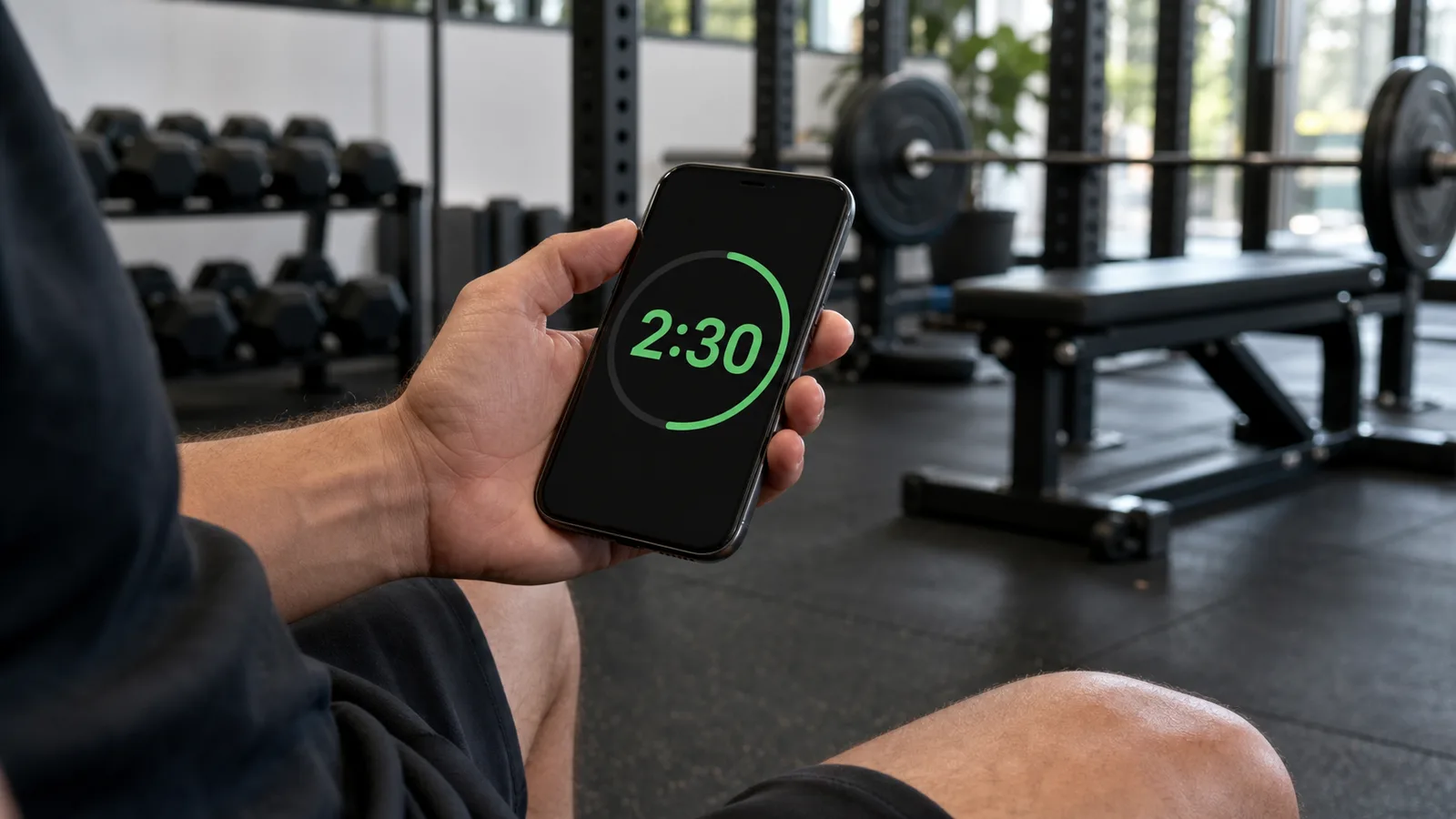
What Is the Best Rest Time Between Sets?
There is no single best rest time between sets. The right range depends on what you are training for and what the set actually demands.
For heavy strength work, longer rest usually helps you keep performance higher across sets. If your goal is to squat, bench, or deadlift heavier weights, cutting rest too short can make the next set worse for the wrong reason. You may miss reps because you are under-recovered, not because the weight is the right challenge.
For hypertrophy, rest should be long enough to keep your reps and form strong. Short rest can make a set feel harder, but feeling more tired is not the same as creating a better muscle-growth stimulus. If your reps drop sharply from set to set, or your form changes, rest longer.
For endurance, conditioning, or lighter accessory work, shorter rest can be useful. It increases workout density and keeps the session moving. The tradeoff is that short rest is usually a poor fit for heavy sets where load, reps, and technique matter most.
A simple rule: rest until you can perform the next set with the effort and technique the workout requires.
Should Compound and Isolation Exercises Use Different Rest Times?
Yes. Compound exercises (squat, deadlift, bench) usually need more rest than isolation moves (curls, flies).
Compound lifts use more muscle mass, more joints, and usually heavier loads. A hard set of squats can tax your legs, trunk, breathing, and setup discipline. A hard set of curls is still useful, but it usually creates less full-body fatigue and takes less time to recover from.
That is why one fixed rest timer is rarely ideal. If every exercise defaults to 90 seconds, you may rush heavy lower-body work. If every exercise defaults to 3 minutes, you may stretch small accessories longer than they need.
This matters most in normal mixed workouts. A push day might include bench press, incline dumbbell press, lateral raises, triceps pushdowns, and planks. Those exercises do not have the same recovery demand.
The practical setup is:
| Exercise type |
Starting rest range |
| Heavy compound lifts |
2-5 minutes |
| Moderate compound lifts |
90 seconds-3 minutes |
| Isolation lifts |
45-90 seconds |
| Core or duration work |
30-90 seconds |
Bazu was built around this exact problem. The free rest timer can use exercise-aware defaults, so a squat can get more recovery than a curl without you resetting the timer every time. If you want to be explicit about it, give an exercise its own goal in your routine — strength, muscle, or endurance — and Bazu sets that exercise's rest from it.
How Long Should You Rest Between Sets for Strength?
For strength, rest 3-5 minutes between hard working sets.
This range is most useful for heavy compound lifts, lower-rep sets, and near-max efforts. Longer rest helps you maintain bar speed, technique, and total reps across the workout. If the goal is strength, the point is not to make every set feel rushed. The point is to recover enough to express force again.
Practical strength ranges:
| Exercise |
Suggested rest |
| Squat |
3-5 minutes |
| Deadlift |
3-5 minutes |
| Bench press |
2-4 minutes |
| Overhead press |
2-4 minutes |
Use the higher end when the set is heavy, close to failure, technically demanding, or followed by another hard set. Use the lower end for lighter work, earlier ramp-up sets, or moderate loads.
Three minutes is not too long for heavy strength work. Five minutes is not unusual for difficult top sets. The mistake is treating long rest as laziness when the goal is performance.
If you are testing a hard set and want to estimate your 1RM (one-rep max), use the Bazu one-rep max calculator after the set. Just do not turn every workout into a max test.
How Long Should You Rest Between Sets for Muscle Growth?
For hypertrophy, rest 1-3 minutes between most working sets.
That does not mean every muscle-growth set should use 60 seconds. Compound hypertrophy work often performs better with 2-3 minutes of rest, especially on leg press, rows, dumbbell presses, and hard machine work. Smaller isolation exercises can often use 45-90 seconds without hurting the session.
Good muscle-growth rest ranges:
| Exercise |
Suggested rest |
| Leg press |
2-3 minutes |
| Dumbbell press |
90 seconds-3 minutes |
| Rows |
90 seconds-3 minutes |
| Curls |
45-90 seconds |
| Lateral raises |
45-90 seconds |
The useful test is performance. If you planned 3 sets of 8-12 and your reps fall from 12 to 7 to 4, rest is probably too short, the load is too high, or the first set was pushed too close to failure. A little rep drop is normal. A collapse usually means the setup needs adjusting.
For muscle growth, rest long enough to keep the target muscle doing quality work. Do not chase fatigue for its own sake.
If muscle gain is the bigger goal, rest time is only one variable. Training volume, progressive overload, food, and recovery all matter. The natural muscle gain calculator and protein calculator can help with the non-timer parts of the plan.
How Long Should Beginners Rest Between Sets?
Beginners should usually rest 60 seconds-2:30, depending on the lift.
The priority is clean reps, consistent technique, and repeatable training. Beginners do not need to rush heavy sets just to feel more tired. They also do not need five-minute rests for every small accessory movement.
Use this simple beginner rule:
| Exercise type |
Beginner rest |
| Big lifts |
2:00-2:30 |
| Accessories |
60-90 seconds |
| Light/core work |
30-90 seconds |
If you are learning squats, deadlifts, bench press, rows, or overhead press, take enough rest to set up well. A rushed set with poor bracing or unstable form is not better training.
If you are doing curls, pushdowns, raises, calves, or light core work, shorter rest is usually enough. The goal is to build the habit of logging, lifting, resting, and repeating without turning every session into a conditioning test.
For a broader beginner progression framework, read Progressive Overload for Beginners.
How Long Should You Rest Between Sets for Endurance?
For endurance, conditioning, or higher-rep circuit work, rest 30-90 seconds between sets.
Shorter rest increases fatigue and workout density. That can be useful when the workout is built around lighter loads, higher reps, circuits, carries, bodyweight movements, or conditioning-style work.
It is not ideal for heavy strength work. If you squat hard, rest 30 seconds, and then miss your next set, you probably did not prove that your strength is low. You proved that 30 seconds was not enough rest for that job.
Use short rest when:
- The load is light or moderate.
- The exercise is technically simple.
- The goal is conditioning or local muscular endurance.
- You can keep form stable as fatigue rises.
Use longer rest when performance, load, or technique quality is the main goal.
What Are the Best Rest Times by Exercise?
The easiest way to make rest periods useful is to set them by exercise type. Here is a practical starting table.
| Exercise |
Category |
Suggested rest |
Why |
| Squat |
Heavy compound |
3-5 minutes |
High full-body fatigue |
| Deadlift |
Heavy compound |
3-5 minutes |
Highest recovery demand |
| Bench press |
Compound press |
2-4 minutes |
Heavy pressing performance |
| Overhead press |
Compound press |
2-4 minutes |
Strength and stability |
| Barbell row |
Compound pull |
90 seconds-3 minutes |
Moderate-heavy fatigue |
| Pull-up |
Compound pull |
90 seconds-3 minutes |
Bodyweight strength |
| Leg press |
Compound lower |
2-3 minutes |
High lower-body fatigue |
| Dumbbell press |
Compound/accessory |
90 seconds-3 minutes |
Hypertrophy performance |
| Biceps curl |
Isolation |
45-90 seconds |
Smaller muscle group |
| Triceps pushdown |
Isolation |
45-90 seconds |
Accessory isolation work |
| Lateral raise |
Isolation |
45-90 seconds |
Small muscle group |
| Calf raise |
Isolation |
45-90 seconds |
Accessory volume |
| Plank |
Core/duration |
30-90 seconds |
Duration-based fatigue |
These are starting points, not laws. A very hard set may need more rest. A warm-up set may need less. A superset, circuit, or short-session plan may intentionally use shorter rest for density.
The important part is not memorizing every row. It is recognizing the pattern: big, heavy, technical lifts usually need more recovery; small, lighter, simpler movements usually need less.
Heavy lifts and accessories should not use the same timer by default. Bazu handles that automatically with its free exercise-aware rest timer, while still letting you adjust the countdown when the set calls for it. For more free training math and planning tools, start from the Bazu tools page.
Is 30 Seconds Enough Rest Between Sets?
Sometimes, but not for everything.
Thirty seconds can work for light accessories, warm-up sets, endurance work, core circuits, and short conditioning blocks. It can also be useful when you intentionally want a dense session with lighter loads.
It is usually too short for heavy strength work. It is also often too short for hard compound hypertrophy sets if your reps drop sharply or your form gets loose.
Use 30 seconds when the exercise is easy to recover from and the load is not the main priority. Avoid it when the next set requires high force, stable technique, or a realistic chance of matching your target reps.
Is 3 Minutes Too Long to Rest Between Sets?
No. Three minutes is reasonable for heavy or hard sets.
It is especially normal for squats, deadlifts, heavy bench press, heavy rows, and tough lower-body machine work. If the goal is strength or quality compound volume, three minutes may be the difference between a productive next set and a sloppy one.
Three minutes can be excessive for small isolation lifts. If you are doing cable curls, lateral raises, or pushdowns, resting three minutes between every set may make the workout longer without much benefit.
Use longer rest when performance matters. Use shorter rest when the exercise is lighter and easier to recover from.
What Mistakes Do Lifters Make With Rest Periods?
Using the same rest timer for every exercise
This is the big one. Squats and curls should not use the same default timer. A fixed timer is simple, but it ignores the difference between full-body compound work and small accessory work.
Rushing heavy sets
Short rest can reduce load, reps, form quality, and progression. If you keep missing reps on heavy exercises, look at your rest time before assuming you need a completely new program.
Resting too long on small accessories
Long rest is useful when performance matters. It is less useful when the movement is small, stable, and easy to repeat. Shorter rests on accessories can keep the session efficient.
Forgetting to start the timer
This is normal gym friction. You log the set, rack the weight, change music, answer a message, and realize the timer never started. An automatic rest timer removes that tiny repeated task.
Letting phone distractions extend rest
Resting longer than planned is not always a problem. But if a 90-second curl rest keeps turning into five minutes because your phone is open, a visible countdown can keep the session moving.
How Can a Workout App Help With Rest Between Sets?
A workout app helps when it removes decisions you should not have to repeat.
Bazu (also on Google Play) includes a free exercise-aware rest timer. When you complete a set, the timer can start automatically. Heavy compound lifts can get longer default rest. Smaller accessories can get shorter default rest. You can still adjust the countdown when a set needs more or less recovery.
That matters because real workouts are mixed. You might go from bench press to dumbbell press to lateral raises to triceps pushdowns. The right rest period changes as the exercise changes. Each exercise in a routine can carry its own goal, so the heavy pressing and the lateral raises get different rest without you managing two settings.
Bazu also supports Apple Watch and Live Activity rest timers, so the countdown can stay visible without unlocking your phone. That keeps rest useful without turning the phone into the center of the workout.
Track your workouts with exercise-aware rest timers in Bazu, so every lift gets the right amount of recovery without extra setup.
Rest Between Sets FAQ
How long should beginners rest between sets?
Most beginners can use 1-2 minutes for general training, 2-3 minutes for heavier compound lifts, and 30-90 seconds for light accessories.
How long should I rest between sets for bench press?
Usually 2-4 minutes, depending on how heavy the set is and whether the goal is strength or muscle growth.
How long should I rest between sets for squats?
Usually 3-5 minutes for heavy strength sets and 2-3 minutes for moderate hypertrophy sets.
How long should I rest between sets for hypertrophy?
Usually 1-3 minutes, with longer rest for compound lifts and shorter rest for isolation lifts.
How long should I rest between sets for fat loss?
Usually 30-90 seconds for circuit-style or conditioning work, but fat loss still depends mostly on total calories, consistency, and training quality.
Should I rest longer if I fail a set?
Usually yes. If reps drop sharply or form breaks down, rest longer or reduce the load.
Should warm-up sets have shorter rest?
Usually yes. Warm-up sets often need less rest than hard working sets.
Should I rest the same amount for every exercise?
No. Heavy compound lifts usually need more rest than smaller isolation or accessory exercises.
Conclusion
Rest between sets should match the work in front of you. Use 3-5 minutes for heavy strength sets, 1-3 minutes for muscle growth work, 30-90 seconds for endurance or lighter work, and shorter rests for most small accessories.
The main idea is simple: rest based on your goal, exercise type, and actual lift. Then use a timer that makes that easy to repeat.
References
- American College of Sports Medicine. Progression Models in Resistance Training for Healthy Adults. Medicine & Science in Sports & Exercise. 2009.
- de Salles BF, Simao R, Miranda F, Novaes JS, Lemos A, Willardson JM. Rest interval between sets in strength training. Sports Medicine. 2009.
- Schoenfeld BJ, Pope ZK, Benik FM, et al. Longer interset rest periods enhance muscle strength and hypertrophy in resistance-trained men. Journal of Strength and Conditioning Research. 2016.
- Grgic J, Lazinica B, Schoenfeld BJ, Pedisic Z. Effects of rest interval duration in resistance training on measures of muscular strength: a systematic review. Sports Medicine. 2018.