Progressive overload for beginners comes down to one practical question: what should I do differently next workout? This guide explains when to add reps, when to increase weight, and what to do when progress stalls — using 2026 guidance from ACSM, CDC, and peer-reviewed research.
Key takeaways
- Progressive overload means gradually making your training harder so your body has a reason to adapt.
- The best beginner question is not "What is progressive overload?" It is "What should I do next workout?"
- A beginner lifter is still building consistent training habits, stable form, and repeatable progress.
- Beginners should usually add reps first, add weight second, and add sets last.
- Research supports useful set and rep ranges, not universal hard caps.
- Strength training and muscle growth use the same principle, but the progression focus is slightly different.
Quick answer
Progressive overload means gradually making your training harder so your body has a reason to adapt.
For beginners, the simplest version is this:
- Pick a rep range, such as 8-12 reps.
- Use the same weight until your reps improve.
- Add weight only when every set reaches the top of the range with good form.
- Track the result.
- Repeat the process next workout.
That is why progressive overload is less about chasing personal records and more about making the next workout clear.
If last workout was dumbbell bench press for 40 lb x 10, 9, 8, your next target is not mysterious. Keep 40 lb and try to beat one set by one clean rep.
Disclaimer: This article is for educational purposes and is not medical advice. If you have an injury, medical condition, or exercise restriction, work with a qualified clinician or coach.
New in Bazu: the Routine Library gives you a complete program to start from, and every exercise in a routine can carry its own goal — which sets that lift's target reps and rest. See what's new →
Who this guide is for
This guide is for beginner lifters.
In this article, a beginner lifter means someone who is in their first year of consistent strength training, returning after a long break, or still learning stable technique on the main movement patterns: squat, hinge, push, pull, carry, and core.
It is not about how strong you are. A beginner is someone who can usually make progress with simple rules, repeated exercises, clean form, and small jumps. Intermediate and advanced lifters need more detailed planning, which will fit better in separate guides.
What progressive overload means
Progressive overload means increasing training demand over time.
That demand can increase through:
- More reps with the same weight
- More weight for the same reps
- More sets for a muscle group
- Better range of motion or control at the same load
- More weekly training frequency when recovery supports it
- More duration for holds, carries, or endurance work
The 2026 American College of Sports Medicine position stand keeps this idea grounded. The paper reviewed 137 systematic reviews. It reported that resistance training improved strength, muscle growth, and several performance outcomes compared with no exercise.
It also found that many details beginners worry about did not consistently drive results for the average healthy adult. That includes equipment type and complex periodization.
The practical implication is clear: use progressive resistance training, but do not confuse progress with complexity.
The research on resistance training is strong enough to support these basics. Worth keeping in mind: most studies are short relative to real training lives, participants vary widely by age and training status, and group averages do not guarantee your individual response. Use the evidence as a starting point and adjust based on your own recovery, technique, and goals.
What should I do next workout?
This is the real question progressive overload should answer.
Use these decision rules:
| What happened last workout? |
What to do next workout |
| You were below the top of the rep range |
Keep the same weight and add 1 rep somewhere |
| You hit the top of the rep range on every set |
Add the smallest practical amount of weight |
| Your form broke down |
Keep the weight the same or reduce it |
| You missed reps because the jump was too big |
Use a smaller jump or rebuild reps |
| You stalled for 2-3 sessions |
Check recovery, reduce the jump, or add 1 set |
| You felt pain instead of normal effort |
Stop that progression and adjust the exercise |
Here is a simple example:
| Week |
Bench press target |
Result |
Next decision |
| 1 |
3 sets of 8-12 |
95 x 8, 8, 7 |
Stay at 95 |
| 2 |
3 sets of 8-12 |
95 x 9, 8, 8 |
Stay at 95 |
| 3 |
3 sets of 8-12 |
95 x 11, 10, 9 |
Stay at 95 |
| 4 |
3 sets of 8-12 |
95 x 12, 12, 12 |
Add weight next time |
| 5 |
3 sets of 8-12 |
100 x 8, 8, 7 |
Rebuild reps |
That is the whole system. The weight changes only after the reps and form earn it.
Start with two full-body workouts
The CDC and WHO both recommend muscle-strengthening work for the major muscle groups on 2 or more days per week.
That is a useful baseline for most beginners. It is enough to practice the main movements without asking too much of your schedule or recovery.
A simple beginner week can look like this:
| Day |
Focus |
Exercises |
| Monday |
Full body A |
Squat pattern, horizontal push, row, hinge, core |
| Thursday |
Full body B |
Hinge pattern, vertical push, pulldown or assisted pull-up, split squat, carry |
Start with 2-3 working sets per exercise. Use a weight you can lift with clean form. Stop with about 2-3 reps in reserve.
A good beginner template:
| Goal |
Starting point |
| Frequency |
2 days per week |
| Sets |
2-3 working sets per exercise |
| Reps |
6-10 for main lifts, 8-15 for accessories |
| Effort |
Stop most sets with 1-3 clean reps left |
| Progression |
Add reps before adding weight |
This is not universal. Some beginners recover well from 3 days per week right away. Others need several weeks at 2 days because of schedule, sleep, soreness, or previous injuries. The right starting point is the one you can repeat.
If your schedule only allows one session per week right now, that still counts. Progressive overload works with one session — progress just comes more slowly. Build the habit first, then add a second day when your schedule allows.
Exercise-specific examples
Progressive overload looks different depending on the exercise. The principle is the same, but the best lever changes.
| Exercise |
Best beginner overload target |
Example |
| Bench press |
Add reps, then small load jumps |
95 x 8, 8, 7 becomes 95 x 9, 8, 8 |
| Squat |
Add reps before load, keep depth stable |
135 x 6, 6, 5 becomes 135 x 7, 6, 6 |
| Deadlift |
Add load slowly and avoid grinding reps |
185 x 5 becomes 190 x 5 only if form stays clean |
| Pull-up |
Add reps first, then added weight later |
bodyweight x 5, 4, 3 becomes bodyweight x 6, 4, 4 |
| Dumbbell curl |
Add reps before moving up dumbbells |
25s x 10, 9, 8 becomes 25s x 11, 10, 9 |
| Push-up |
Add reps or harder variations |
3 x 10 becomes 3 x 12, then feet-elevated push-ups |
| Bodyweight squat |
Add reps, pauses, or load |
3 x 15 becomes goblet squats or slower reps |
| Plank or carry |
Add time, distance, or load |
30 seconds becomes 40 seconds before adding weight |
For bodyweight exercises, do not wait until you can add external load. More clean reps, longer holds, deeper range of motion, and harder variations all count.
Strength vs muscle growth
Strength and muscle growth both use progressive overload, but they do not need the exact same emphasis.
| Goal |
What to prioritize |
Beginner rule |
| Strength |
Load, stable technique, lower-to-moderate reps |
Add weight once reps and form are solid |
| Muscle growth |
Reps, sets, weekly volume, controlled execution |
Build reps and sets carefully before chasing load |
| General fitness |
Consistency across major muscle groups |
Repeat the plan and progress one small variable |
The 2026 ACSM position stand supports heavier loads for building strength and higher weekly volume for muscle growth. For beginners, that does not mean every set needs to be heavy or high volume.
A 2023 systematic review and Bayesian network meta-analysis reached a similar practical conclusion. Higher-load plans ranked best for strength. Multiple-set plans were important for muscle growth.
If your goal is strength, the long-term direction is heavier loads. If your goal is muscle growth, do not ignore load. But pay close attention to clean reps, total hard sets, and repeatable weekly work.
Set and rep guardrails
There is research-backed guidance on sets, reps, load, and weekly volume. There is not a universal hard maximum for every compound or accessory lift.
The better beginner approach is to use guardrails.
| Exercise type |
Practical beginner range |
When to stop adding reps |
| Heavy compound lifts |
2-3 working sets of 3-8 reps |
When reps slow sharply or form changes |
| Moderate compound lifts |
2-3 working sets of 6-10 reps |
When all sets hit the top cleanly, add load |
| Accessory lifts |
2-4 working sets of 8-15 reps |
When 15s are clean, add load or difficulty |
| Isolation lifts |
2-4 working sets of 10-20 reps |
When higher reps become easy or sloppy |
| Bodyweight exercises |
2-4 working sets of 8-20+ reps |
When reps are high, use a harder variation |
| Holds and carries |
2-4 sets of 20-60 seconds |
When time is easy, add load or distance |
For beginners, a useful weekly volume target is about 6-10 hard sets per major muscle group. The 2026 ACSM position stand highlights about 10 sets per muscle group per week as a practical muscle-growth target.
Older meta-analysis work also found a positive relationship between weekly set volume and muscle growth. More is not automatically better, especially if soreness, joint discomfort, sleep, or performance starts moving the wrong direction.
Use these guardrails in practice:
- If a compound lift is above 10 clean reps on all sets, consider adding load.
- If an accessory lift is above 15 clean reps on all sets, consider adding load.
- If an isolation lift is above 20 clean reps, consider adding load, slowing the lowering phase, or choosing a harder variation.
- If a bodyweight movement goes far past 20 clean reps, consider a harder variation before adding endless reps.
- If you already have 10 hard sets for a muscle group that week, add more only if recovery and performance are still good.
These are guardrails, not laws. High-rep squats can build muscle. Low-rep curls can build strength. But for beginners, clear ranges make the next decision easier and safer.
How to overload safely
Progressive overload works best when the increase is small enough to recover from.
Use these safety rules:
- Keep form stable before adding weight.
- Use the smallest practical load jump.
- Leave 1-3 clean reps in reserve on most beginner sets.
- Do not turn normal training into max testing.
- Stop or modify the lift if you feel sharp pain.
- Sleep, food, and rest days matter because adaptation happens after training.
- Avoid ego lifting. A smaller lift with clean form is better than a heavier lift you cannot repeat.
- Keep most beginner muscle groups near 6-10 hard sets per week before adding more volume.
A common beginner mistake is adding too much weight at once. These jumps work for most beginners:
| Lift type |
Practical load jump |
| Upper-body barbell (bench, overhead press, row) |
2.5–5 lb total (1.25–2.5 lb per side) |
| Lower-body barbell (squat, deadlift) |
5–10 lb total |
| Dumbbells |
Smallest available increment, typically 5 lb per dumbbell |
| Bodyweight |
Move to the next harder variation when the current one feels easy |
If the standard jump feels too large for an upper-body lift, fractional plates (0.25–1.25 lb) are worth the investment. A smaller jump you can repeat beats a larger one that stalls you for weeks.
The goal is not to make every session harder at any cost. The goal is to make training harder only when your body is ready for the next step.
How to track progressive overload
Progressive overload requires comparison. You need to know what happened last time so you can make a calm decision this time.
At minimum, track:
- Exercise
- Weight
- Reps
- Sets
- Whether the set was completed
- A short note when something meaningfully affected performance
Do not make every workout a one-rep-max test. Beginners can progress for a long time by improving normal working sets. When you do want a quick estimate from a hard set, use the Bazu 1RM calculator. If the lift is bench press, the Bench Press Calculator gives the same estimate with bench-specific training percentages and percentile next steps.
For beginners, the lesson is simple: keep enough history to know what improved, then make the smallest useful change.
What to do when progress slows down
Progressive overload does not mean progress every session forever. Performance will slow. That is normal.
Before changing the program, check the simple factors:
- Are you repeating the same exercises long enough to measure them?
- Are you training the lift too close to failure every session?
- Are you sleeping enough to recover?
- Are you eating enough total food and protein for your goal?
- Are the weight jumps too large for the lift?
If protein intake is the unknown, estimate a practical daily target with the Bazu protein calculator.
If a lift stalls for 2-3 sessions, use this order:
- Hold the weight steady and try to improve one rep somewhere.
- Reduce the jump. For upper-body lifts, small jumps often matter.
- Add a back-off set only if recovery is good.
- Deload for one week if every set feels worse and fatigue is high.
A beginner deload can be simple:
- Reduce load by about 5-10%
- Keep the same exercises
- Stop sets with several reps in reserve
- Return to normal progression the next week
Do not treat a stall as proof the plan failed. A stall is feedback. It tells you the current dose, recovery, or progression jump needs adjustment.
Use Bazu to simplify progressive overload
Bazu is a free workout tracker for iOS. It logs your exercises, sets, reps, and weight, and keeps that history visible so you are never starting from memory when you walk into the gym. If you do not have a routine yet, the free Routine Library has complete beginner programs you can read in full before starting one.
The hardest part of progressive overload is not knowing the rule. It is remembering the exact weight and rep count from your last session when you are already standing at the rack.
Progressive Overload is a feature inside Bazu, available on subscription, that reads your logged history and generates a specific next target for each exercise. Log the lift, and the app tells you whether to add a rep or step up in weight — no mental math needed. A pace selector lets you choose conservative, standard, or aggressive progression based on your training experience and recovery, and Bazu prefills pending working sets with the current target.
The general guardrails above give room to adjust by goal and exercise. Bazu uses tighter rep bands during workouts to keep the next target unambiguous, and each exercise in a routine can carry its own goal — so a heavy squat and a leg press get different bands instead of sharing one app-wide setting.
| Progression pace |
Compound rep band |
Isolation rep band |
| Standard |
5-8 |
10-12 |
| Conservative |
5-8 |
10-15 |
| Aggressive |
4-6 |
8-10 |
A target appears when both conditions are true:
- The exercise has at least 2 completed workouts.
- The exercise tracks reps plus weight.
Bazu looks at your last 2 workouts for that exercise and uses your best eligible working set. Sets explicitly marked as warm-ups are excluded from PR, volume, and Progressive Overload calculations. When you mark a warm-up, Bazu also suggests a warm-up weight; you can override that number without changing its warm-up status. Then Bazu shows one clear working-set recommendation:
| Recommendation |
What it means |
| Add Reps |
Stay at the same weight and aim for one more rep |
| Increase Weight |
You earned the top of the rep band; add load and rebuild reps |
| Repeat Weight |
Hold the same target to stabilize before progressing |
| Reduce Weight Slightly |
Repeated regression suggests a small reset |
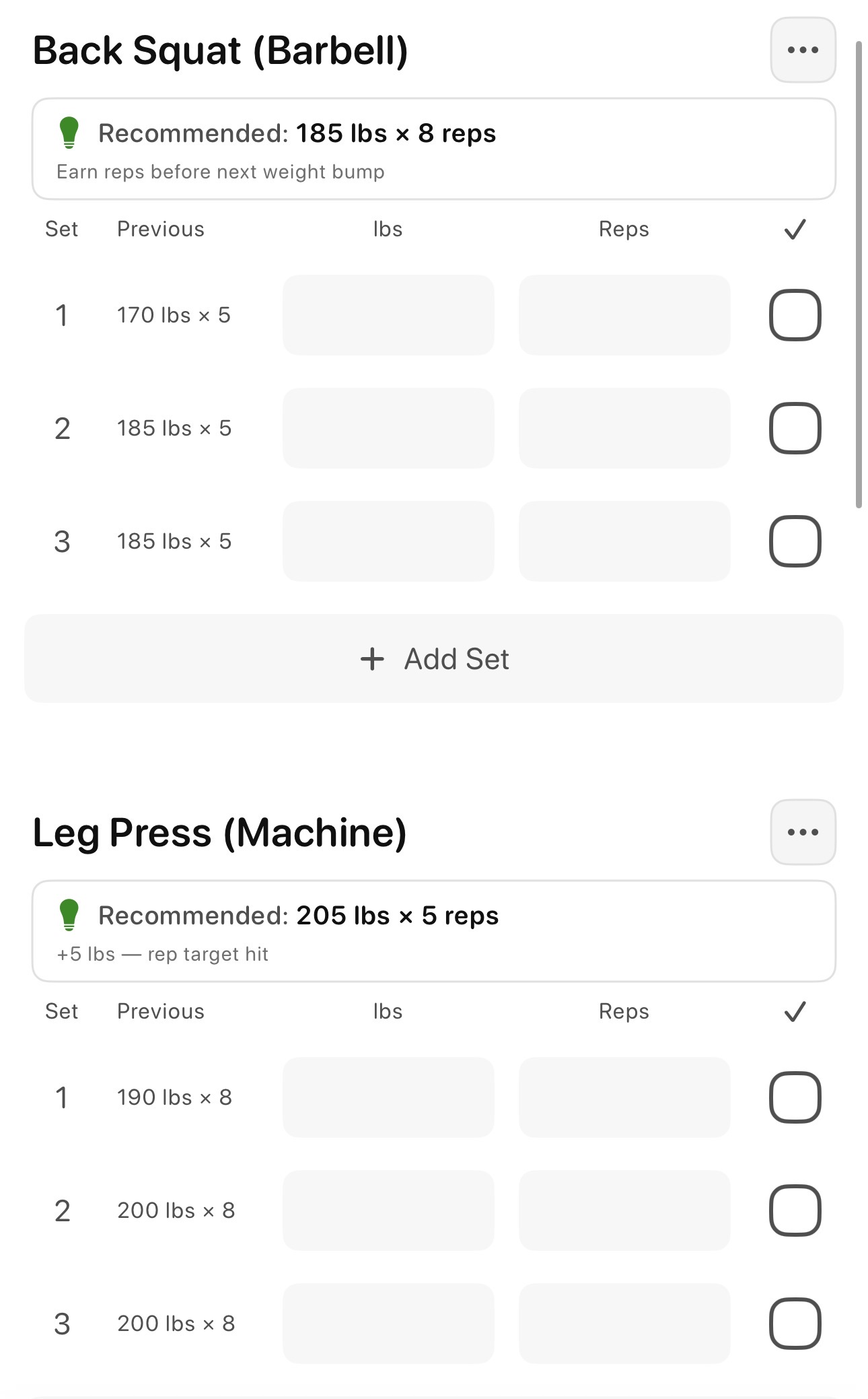
Bazu shows the next target directly in the workout, so the decision is visible before you start the set.
See the smart warm-up and prefilled-target release details.
Bodyweight exercises get reps-only targets until you add external load. Timed exercises and cardio do not get Progressive Overload targets because the rep-band model does not fit them cleanly.
Bazu also turns your history into an insight view. A green trend means the exercise is moving up over time. A yellow trend means recent performance is drifting down, which is a signal to check recovery, form, or progression jumps.
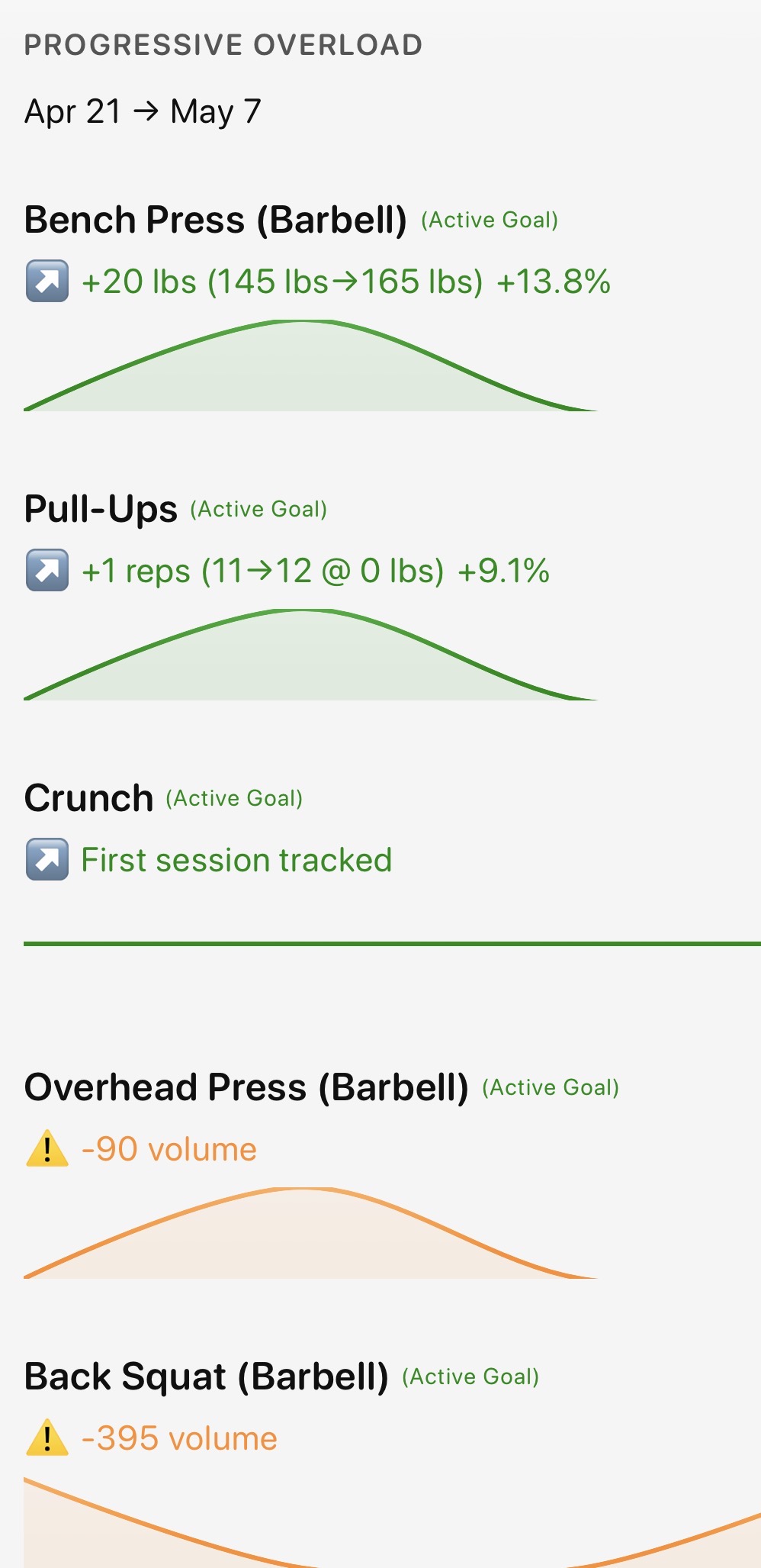
Progressive overload is easier to manage when your trend is visible, not buried in old workout notes.
For beginners, the conservative path is usually the best starting point. It gives you room to practice form, build confidence, and avoid turning every session into a grind.
Bazu does not need to make training noisy to make it smarter. The goal is simple: remove the mental math, keep your history visible, and help you progress one clean step at a time.
Conclusion
Progressive overload for beginners is not complicated.
Train the major muscle groups at least twice per week. Pick stable exercises. Use rep ranges. Add reps before weight. Track enough to know what you did last time. When progress slows, adjust the smallest useful variable.
That is the whole system: measurable training, repeated calmly.
If you want to go deeper on the principles, Progressive Overload 101 covers the fundamentals in more detail, including rep ranges, how hard to train, and what to do when you stall. If you use Bazu and want to understand how personal records are calculated, see How Bazu Calculates PRs. When you want to benchmark a lift by bodyweight, try the Strength Standards Calculator.
FAQ
Who counts as a beginner lifter?
A beginner lifter is usually someone in their first year of consistent strength training, someone returning after a long break, or someone still learning stable technique on the main movement patterns. It is not a judgment of strength. It is a way to choose the right progression rules.
Should I add weight every workout?
No. Add weight only when you reach the top of your target rep range with clean form. On many beginner sessions, adding one clean rep is enough progress.
Is progressive overload only for lifting?
No. Progressive overload can apply to bodyweight training, loaded carries, holds, and other measurable exercise progressions. In strength training, it is easiest to track through reps, load, sets, range of motion, or duration.
Should beginners use progressive overload?
Yes, but beginners should use it conservatively. The goal is steady improvement with clean form, not forcing heavier weights before the movement is stable.
What if I cannot add weight?
Keep the same weight and add reps. If that is not possible, add a set, improve range of motion, slow the lowering phase, reduce rest a little, or choose a harder variation.
How many reps before increasing weight?
Use a rep range. If your target is 8-12 reps, increase weight only after every working set reaches 12 clean reps.
Is there a maximum number of sets or reps I should do?
There is no universal hard maximum, but beginners should use guardrails. Start with 2-3 working sets per exercise. Use roughly 6-10 reps for most compound lifts, 8-15 reps for accessories, and 10-20 reps for lighter isolation or bodyweight work. If you keep beating the top of the range with clean form, increase load or difficulty.
Can Bazu help with progressive overload?
Yes. Bazu is a free workout tracker for iOS that logs your sets, reps, and weight so your history is always there when you need it. The Progressive Overload feature, available on subscription, uses that history to show a specific next weight and rep target for each exercise — so the decision is made before you pick up the bar.
References
- American College of Sports Medicine. "ACSM Unveils Landmark 2026 Resistance Training Guidelines - First Update in 17 Years." Published March 17, 2026. https://acsm.org/resistance-training-guidelines-update-2026/
- Currier BS, D'Souza AC, Fiatarone Singh MA, et al. "American College of Sports Medicine Position Stand. Resistance Training Prescription for Muscle Function, Hypertrophy, and Physical Performance in Healthy Adults: An Overview of Reviews." Medicine & Science in Sports & Exercise. 2026;58(4):851-872. doi:10.1249/MSS.0000000000003897. PubMed: https://pubmed.ncbi.nlm.nih.gov/41843416/
- Currier BS, Mcleod JC, Banfield L, et al. "Resistance training prescription for muscle strength and hypertrophy in healthy adults: a systematic review and Bayesian network meta-analysis." British Journal of Sports Medicine. 2023;57(18):1211-1220. doi:10.1136/bjsports-2023-106807. PubMed: https://pubmed.ncbi.nlm.nih.gov/37414459/
- Schoenfeld BJ, Ogborn D, Krieger JW. "Dose-response relationship between weekly resistance training volume and increases in muscle mass: A systematic review and meta-analysis." Journal of Sports Sciences. 2017;35(11):1073-1082. doi:10.1080/02640414.2016.1210197. PubMed: https://pubmed.ncbi.nlm.nih.gov/27433992/
- Centers for Disease Control and Prevention. "Adult Activity: An Overview." Updated December 20, 2023. https://www.cdc.gov/physical-activity-basics/guidelines/adults.html
- World Health Organization. "WHO guidelines on physical activity and sedentary behaviour." Published November 25, 2020. https://www.who.int/publications/i/item/9789240015128